
The layout rationale is very simple and obvious: assume that the proposed extenstion was built by a nominally independent company, which was absorbed by the Great Eastern Railway in 1897 along with the Downham and Stoke Ferry Railway, after being operated by the GER since opening.
Planning was another matter. I have a useful space in my spare room which is touch over 4m long, and I knew from my previous layout, Sulgrave Manor, built over 30 years ago that a 1m (or 40”, near enough) long baseboard is fairly easily transported about the house and into the car for exhibitions, etc. four such boards can be bolted into facing pairs for transport, providing a degree of protection during transit and storage. I also knew from that previous layout that just 4 turnouts could create an interesting layout in 3m, including a sector plate fiddle yard. Those 4 turnouts soon became 5 under my ownership, however, which did make things slightly less boring at a 2-day exhibition! The scenic portion of this layout was 88″ long and 17″ wide, by the way. The layout appeared at Leicester in 1995, the Scale Show in 1996 (for which Barry Norman drew the original layout plan) and at Railwells in 1999.
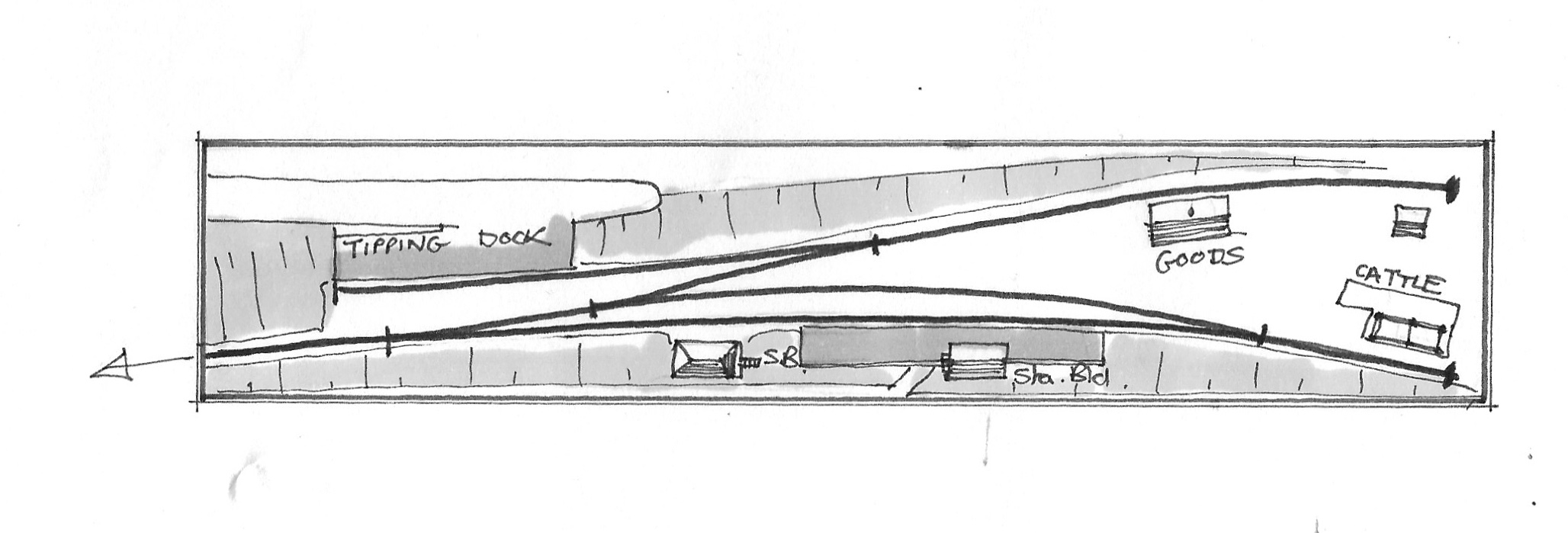
It was at the latter show that the extra siding first appeared.
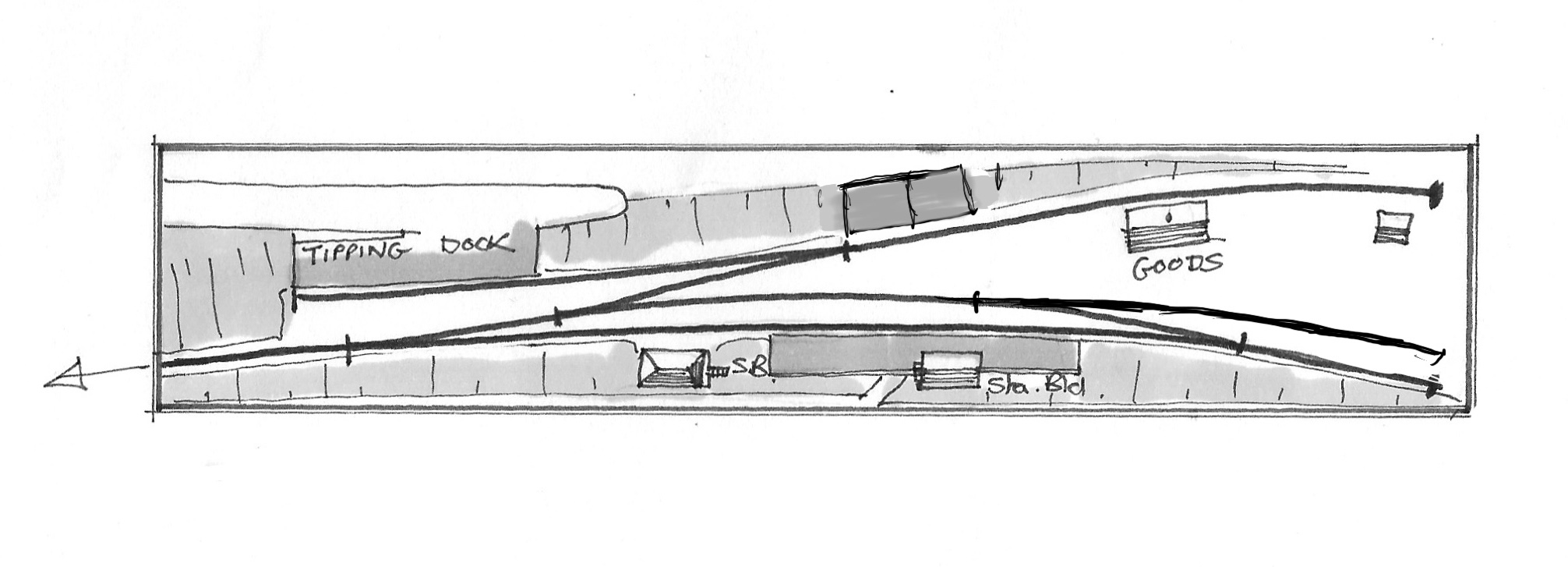
At Railwells, the layout was in transition to a Cambrian Railways themed layout, called Llanfair, owned and operated by my late friend John Coulter, under which aegis it was better known.
The first thoughts, then, were to build a layout using three of the boards for scenic purposes, and the fourth for use as a fiddle yard.
Thoughts then turned to the layout design: not just the track plan, but how the facilities would be arranged, and how this would fit into the available space, and how it might serve the local community. Basic traffic would be straightforward, using Stoke Ferry as a starting point. This means coal and general merchandise inwards, malted grain and agricultural produce outwards, with a regular cattle traffic both ways as calves are brought in for fattening, etc, and then shipped out to market “on the hoof”. Passenger traffic would not be very heavy, except on market day in nearby Downham Market and possibly Kings Lynn, but there is the tantalising prospect of the occasional special and indeed royal train service arriving in connection with nearby Oxborough Hall – which actually happened at Stoke Ferry. There was already an engine shed at Stoke Ferry, and as it was a scant 2-3 miles away, I am assuming that this remained in use, with the branch loco making an “empty stock” move from Stoke Ferry every morning and end of day with the coaching stock.
This all indicates a single platform for passenger traffic, a loading dock with capacity to handle cattle, maybe horse boxes and possibly “end loading” of carriages and agricultural machinery onto flat wagons, etc, a goods shed, external crane and a road for general goods and coal. The grain traffic would probably be in sacks, and there might be a maltings next to the station (possibly served directly from the railway) or double-handling might be involved, using barrows, trolleys or carts – at Stoke Ferry, the maltings were established before the railway arrived, were served by water (the River Wissey) and were located across the road from the station.
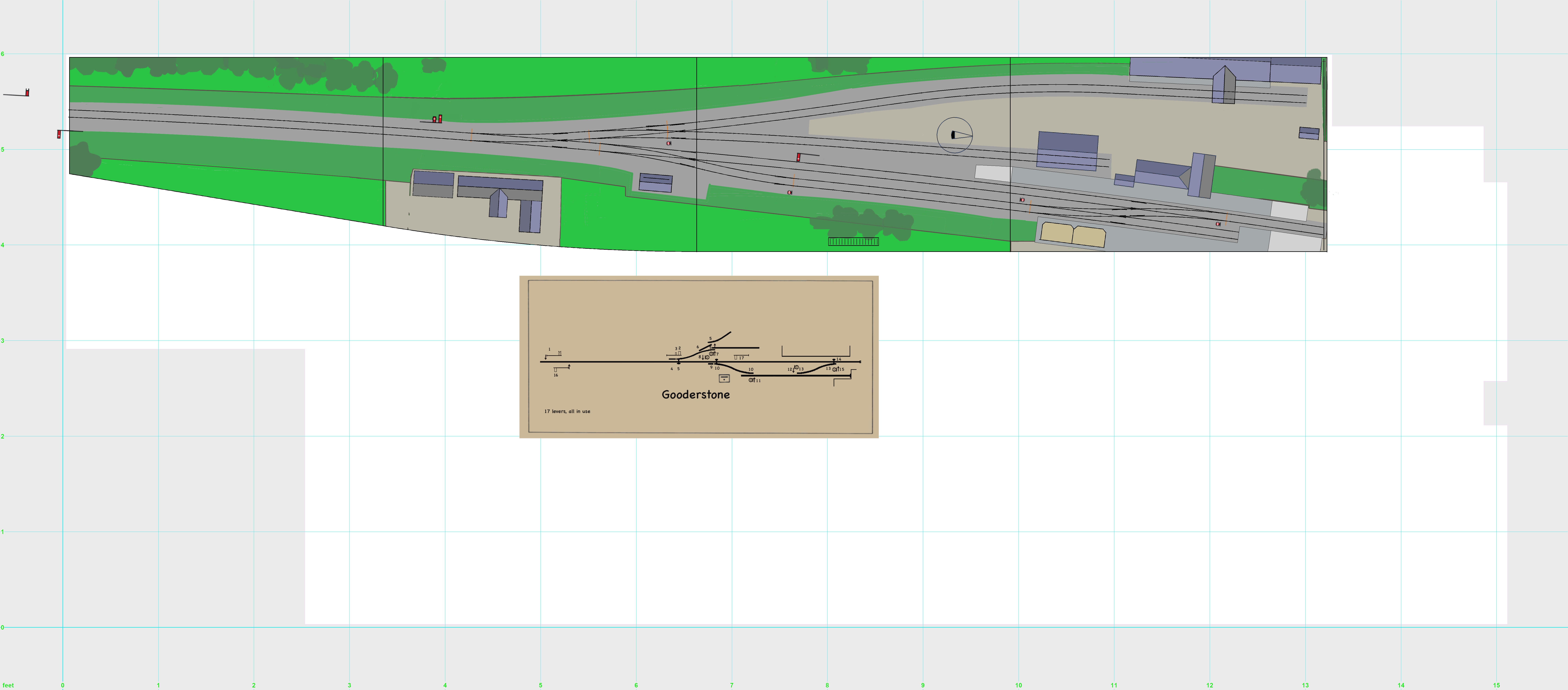
The options, then, were to create a terminus from basic principles, or to find a prototype that could accommodate this traffic in a fairly small space. That actually ruled out Stoke Ferry as the basis for the layout, as although quite a small station, it was quite open and modelled to scale required about twice the length and width that I had in mind! It can be compressed to a degree, but not enough to suit my space whilst looking realistic. But the lovely branch terminus at Eye in Suffolk held a lot of promise. If you have seen the lovely P4 model of Flintfield, you will be aware that this wasn’t a very long station, but it was quite wide. But it gave me the basis for the first idea. Whilst I was about it, I extended the short coal stub siding. I have shaded the strange outline of the room in grey, too.
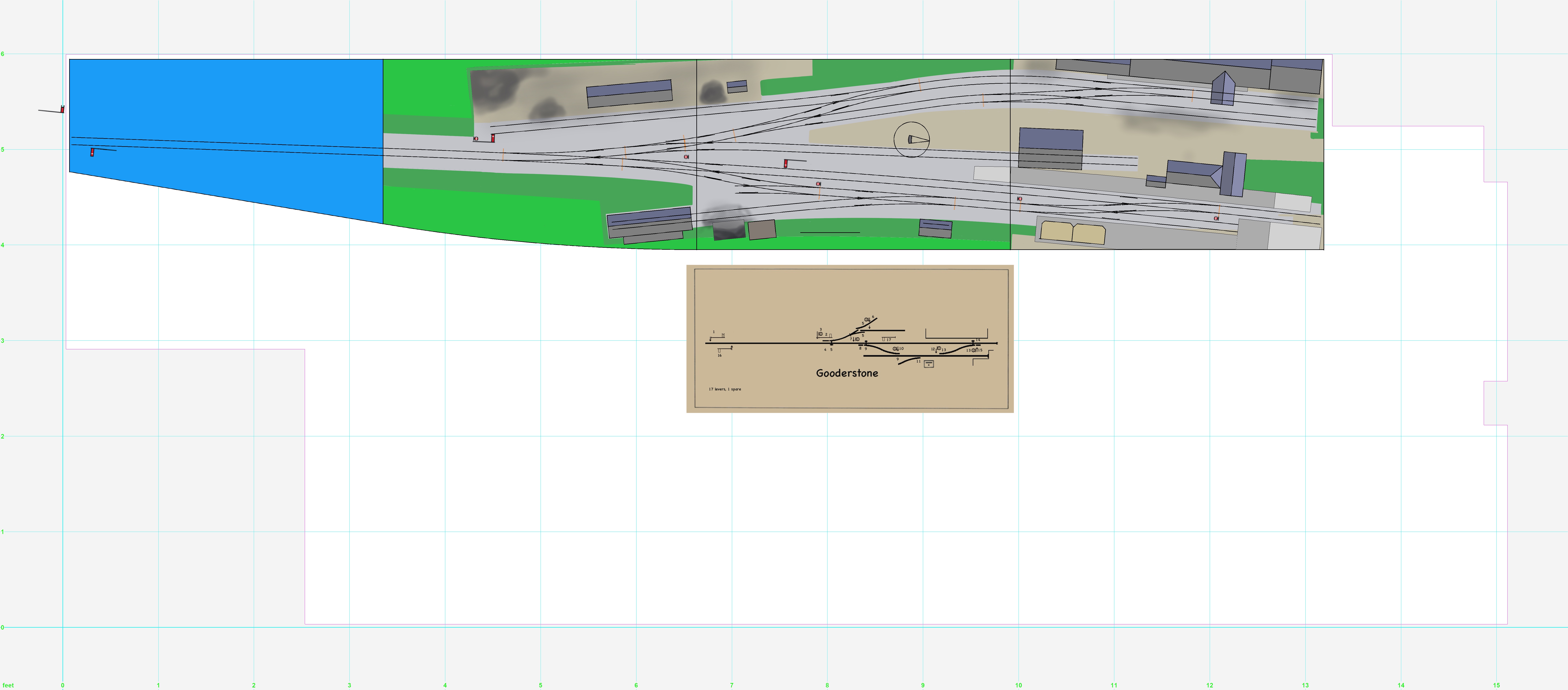
The problem with this plan was that shunting to and from the goods yard meant entering the fiddle yard, which I felt would be the model railway equivalent of “breaking the fourth wall”. This isn’t a deal breaker for many – and ultimately not one for me, either – but I thought it might be nice to avoid this.
And then the penny dropped. My very good friend Geoff Forster dealt with this issue on his 7mm finescale Bleddfa Road layout by not having a fiddle yard: there is a length of track out in the visible scenicked area on which trains are assembled before operating, and from which they are removed afterwards. (Geoff is not a great fan of operation, preferring to create beautiful scenes, but trains must run smoothly and reliably when he does run them.) It occurred to me that at home, I would not be operating the layout intensively and it seemed a shame for a quarter of it to be undecorated for the sole purpose of providing somewhere to rearrange trains for a couple of minutes. For exhibition use (should I get invited, although that is the intention) then space is usually less of an issue and I can have an additional piece bolted on, to enable more variety of trains to be supplied and prepared in advance of the operator needing them. I added a turntable to Eye, in place of the loco shed, on the basis that goods trains from Kings Lynn might be operated by tender locos, and also this would be useful when specials arrived for Oxborough Hall and added a siding for storing carriages parallel to the main line.
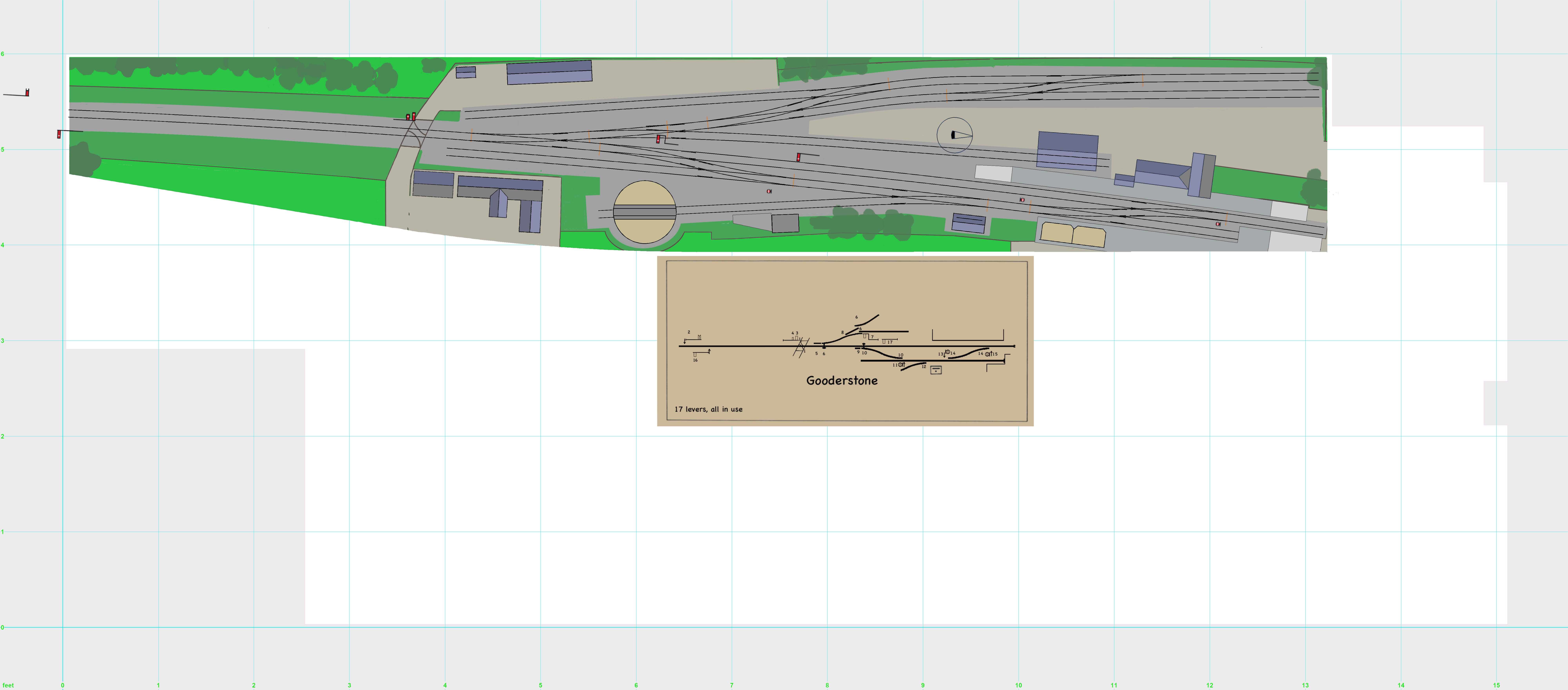
That solved this, and I moved on to making the baseboards and laying track, which will appear soon, after the following caveat…
During construction. I felt that the goods yard was a little cramped, and pondered on the turntable and carriage siding, too. These were plausible, assuming that maybe Gooderstone was larger than it is (or ever was) but I wondered if I had fallen into the trap of building the layout equivalent of “Bhudda’s pizza” (make me one with everything)? So, despite having cut a hole for the turntable and laid the sleepers for the complicated goods yard, I cut things back, and now have 5 turnouts plus a couple of catch points – shades of what I had on Sulgrave Manor, but differently arranged and more spread out.
 The Erratic and Wandering Journey