(In)tolerance

There has been a flurry of letters recently in the illustrious “Model Railway Journal” which have left me bemused. My hobby activities are an escape from “real world” pressures, so mostly I take other people’s opinions as being just that: other people’s opinions, and life is easier if people remember to separate opinions from facts… …so I could carry on ignoring the letters, which is what I mostly do, but there were mentioned more than once over the recent weekend, whilst I was attending the superb Uckfield Model Railway Exhibition with East Lynn: and the comments were from well-regarded modellers who were similarly bemused.

It is not the comments themselves, so much as the tone, which is getting increasingly strident if not dictatorial at times. Don’t get me wrong, I really do enjoy getting insights into how other people organise themselves to be more productive (because I struggle with this, but am getting better), and some of the suggestions I may well pick up and adopt, but please, just because something works for you, it doesn’t mean it will work for everyone else (or even anyone else) so please refrain from telling us it if the only way to achieve “success”. Otherwise I might come round to your house and tell you to scrap everything, and start again – scratchbuilding in S scale, because I find it works for me…

The most bizarre letters were about exhibitions: why do we have them, and how annoying it is to see mentions in magazines that this layout will be on show at the XYZ MRC exhibition next month. Obviously, if you don’t like them or understand why other people do, then don’t go. And a short sentence highlighting that you can go and see a layout at a forthcoming event is just a courtesy to those who do like going to exhibitions, but harms no one who doesn’t.

I should add that I am not bemused at the attitudes presented in the letters – it would be a boring world if we all thought the same things, as I hope is obvious – but why they were even published, as it seems to me to be a sterile subject for debate at best, and a public display of pigheaded intolerance at worst.

Anyway, by pure chance, WordPress reminded me it was 8 years since I posted on the subject, so I am adding to/reposting a blog from 8 years go, on “Standards”, which seems germane.
Sums

At the recent Uckfield Model Railway Exhibition, a member of the public tried to suggest that quoting the track gauge to a thousandth of an inch was a bit extreme, and why not use 0.9” instead? Well, ignoring the trite response that 0.9” can also be expressed as 0.900” – and often is in engineering circles to specify the required level of accuracy (which otherwise covers 0.850” to 0.949”), the simply fact is that we don’t actually use the decimal fraction, merely divide 56 ½ inches (standard gauge) by 64… (And yes, I know that results in 0.883”, and the SSMRS standard is 0.884”, but there are technical reasons for that, due to engineering tolerances required for an exact scale wheel profile.) In truth, when I started in S, I didn’t have a track gauge, but I did have a (cheap) vernier calibre which was calibrated in 1/128” of an inch – scale half inches in S scale: I quickly took it to ⅞” (a scale 56 inches, and used the fine adjustment to add the extra single graduation – an extra 1/128”, or 0.008” if you must have it as a decimal!)

I recently realised that when we say S scale is 3/16” to the foot, this is slightly misleading. It is entirely true, but it happens to the result of simplifying 12/64”, which possibly expresses the vulgar fraction in a way that explains exactly what we are doing by referencing the scale ratio. But we run up against people thinking we measure everything in terms of how many 1/64” it is, which is patently silly but reflects the poor standard of mathematical understanding in everyday life. For the record, when using mental arithmetic it gets much quicker, as ¾” represents 4’ on the prototype, 3” 16 feet and so forth. Or one can buy a “scale ruler” and just that!

And whilst we are about it, the MRSG and the P4 society invented neither “true scale” model railway standards nor indeed “finescale railway modelling”: they merely promoted it in the most popular scale in the British Isles. Aside from the rarely acknowledged systematic derivation of the track standards for S scale undertaken by Ian Pusey in the early 1960s (which influenced the self-styled “Model Railway Study Group” soon afterwards) people like Jim Richards, working in 7mm scale, had been dividing prototype dimensions by their chosen scale ratio for years beforehand, and Charles Wynne effectively defined finescale back in 1919, when he set himself a standard of accuracy for his own modelling (to the nearest scale inch: maybe not much compared to some, but a lot better than what was going on elsewhere at the time!) The same is true about the benefits of allowing wheels to move up and down, whether sprung, “compensated” or via a mixture of the two, as the prototype often did.

Wicken

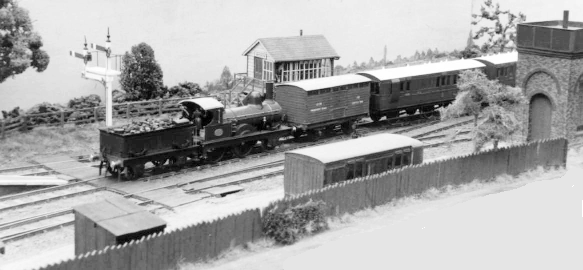
When Trevor Nunn started in S scale, he built a simple portable layout called “Wicken”. This turned out to be an influential layout, because it demonstrated clearly just how much was achievable in S scale with just a few basic components. Influential? Many S scale modellers (indeed, many modellers working in S scale!) had their first exposure to 1:64 railway modelling by seeing this layout at an exhibition, including yours truly. The layout was documented in issue 10 of the Model Railway Journal, which included the memory able line “when it comes down to it, one doesn’t need many items to build a model railway”. That’s a very neat encapsulation of Trevor’s approach to railway modelling, and which continued as he built East Lynn, the Quayside Extension, Nunstanton and finally Trowland.

I have created a page on the layout. Enjoy if you visit!