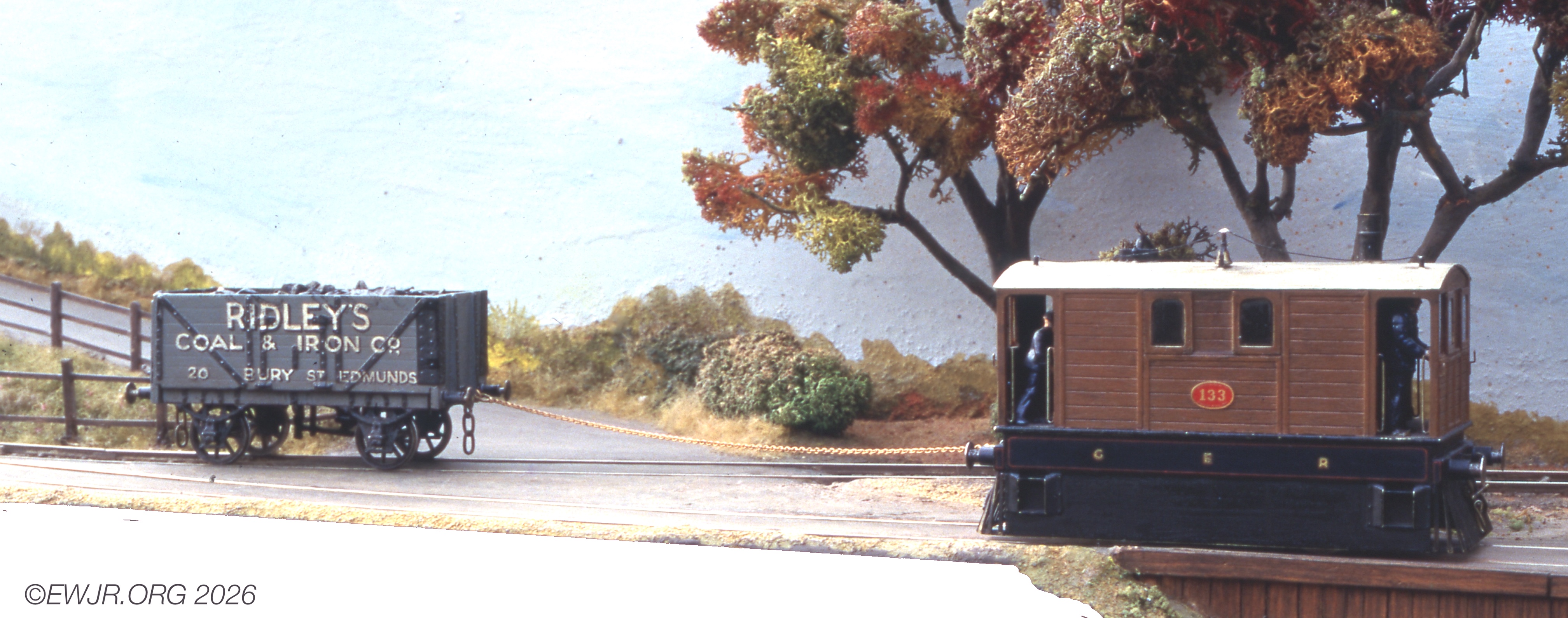
Wicken – named and located roughly for the undrained fen north east of Cambridge – was intended to be a lightweight, portable layout to test out the suitability of S scale, and to last a couple of years. House-moves and renovations (something Trevor enjoyed doing) plus the demands of a growing family meant that it lasted a couple of decades, during which stock gradually accumulated and more details were added to the layout. Some slides were discovered when going through Trevor’s effects, and thanks to Adrian Marks, they have been scanned and are shared here in memory of a great layout and an even greater friend.

At one stage, ideas were entertained about the possibility of running passenger trams from the bay platform onto the tramway, and taking inspiration also from Kelvedon Low Level station, there was a slightly improbable double slip in the layout plan. There were occasional ideas about making the bay platform a goods only road, but at exhibitions it was very useful for making up trains prior to departure, allowing incoming trains to arrive and be able to run round.
Stock and Components
At first, stock was loaned from other members of the S Gauge Model Railway Society, as it was then called – not that there was much of it about at the time – and for a while there were a number of wagons lettered MET running on the layout, courtesy of the generosity of the late Alan Cruickshank.
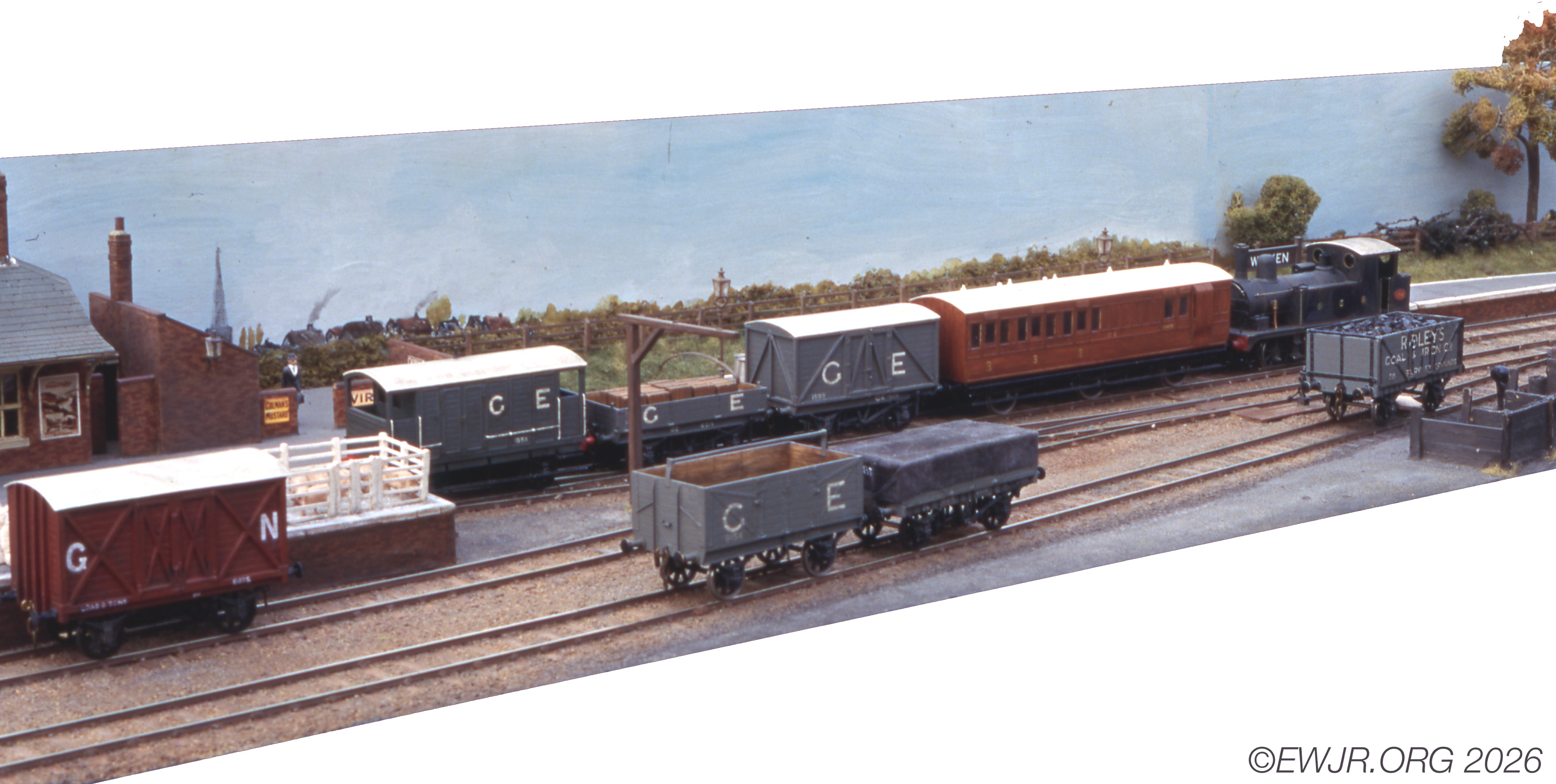
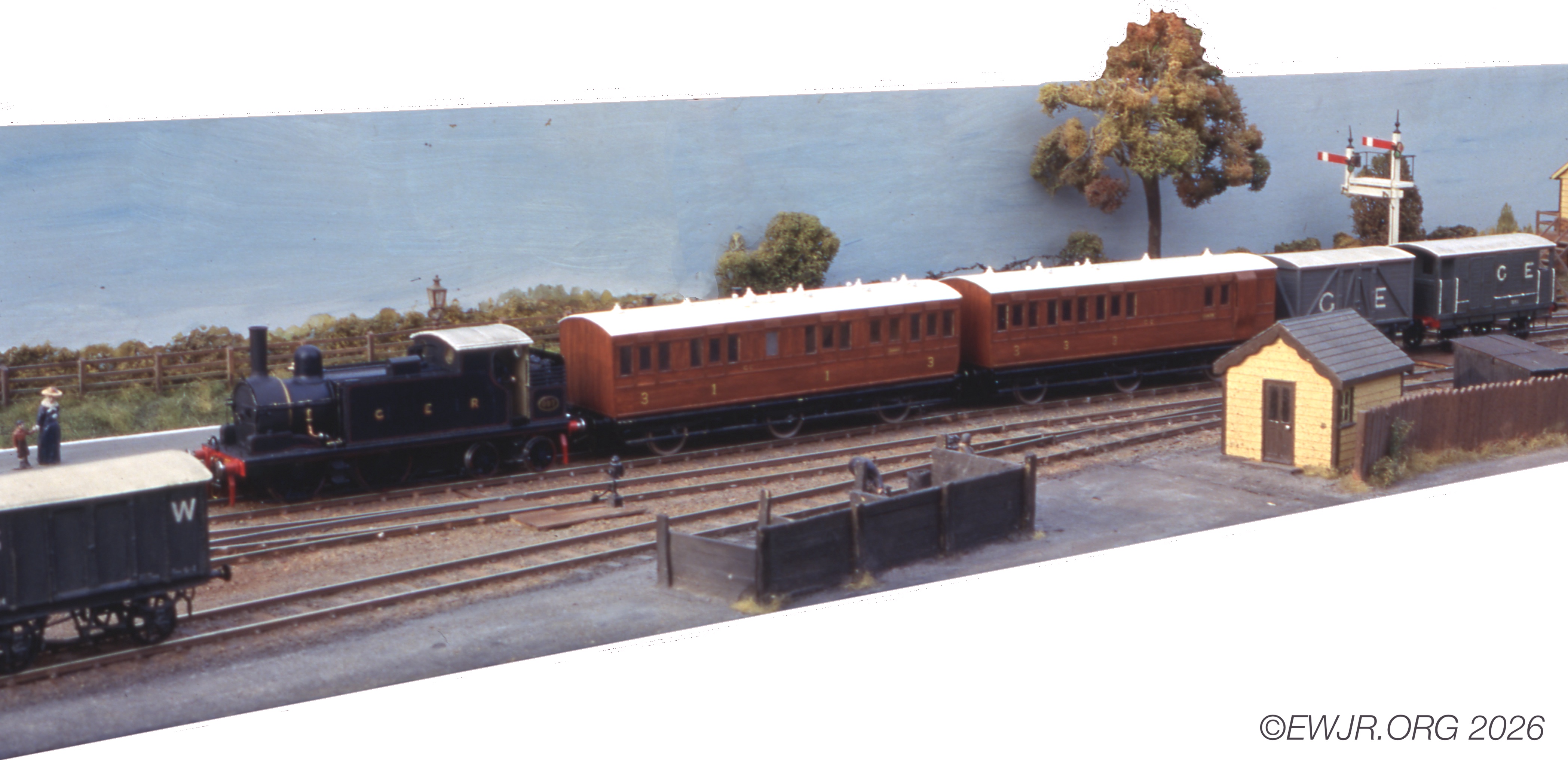
Gradually, though, the branch passenger service acquired the proper stock: 2 six wheel coaches and an E22 (J65) 0-6-0T, and appropriate wagons appeared, using cast whitemetal kits for private owner wagons and wood and metal foil for other wagons.

“Bought in” components were buffers (a lot of ERG “4mm scale” stocks and rams – ideally sized for S) and wheels, axle guards (W-irons) plus castings for axle boxes, springs and parts of the brake gear, with initially Jackson 4mm scale 3-link and screw couplings (slightly oversize even for S!) which were later replaced with hand wound links from 22SWG wire. Other than the “code 95” rail (again sold as being “4mm scale”) these plus the motors and gears and one set of driving wheels (on the 209 class 0-4-0ST “coffee pot”) were the only items purchased for building the layout. I should add that any castings were produced from patterns made by members within the Society (frequently Trevor himself) and cast for the use of members. The etched axleguards were 4mm scale items re-sized for S by the manufacturer (Colin Waite), and the wagon wheels were latterly produced by Alan Gibson.

Trevor had already modified RTR and built kits for other people, and latterly scratchbuilt a superb B1 and E4 in 00, which regularly ran on the Bury St. Edmunds club layout in the early 70s. His next project had he not “discovered” S would have been an Ivatt 2MT 2-6-0. Being from Cambridge, he was obviously aware of the Great Eastern Railway and decided that if he was going to work in S scale where he would perforce have to make most items, he may as well model a prototype where there were not many items available as kits, and he had acquired the skill and most importantly the confidence to have a go.

An Ideally Sized Layout for Promoting the Ideal Scale
Trevor felt that Wicken was more effective at promoting S scale in some ways than East Lynn, as it was for most people a more “achievable” concept. Cyril Freezer when writing about the situation of the hobby in the late 40s and 1950s made a similar point: a portable branch line terminus layout that can be stored away when not set up needs a couple of locos, two or three coaches and between a dozen and a score of wagons, but if building largely from scratch, that is going to take some years to get together. But – depending on how much time one has to devote to the hobby (and let’s be honest, this is ultimately a self-focused activity for nobody else’s benefit!) this could easily be between 2 and 10 years. As it happens, because of the materials Trevor liked to work with (wood, paper, card and pva glue) then quite a lot of the buildings and wagon bodies could be assembled in front of the TV in the living room, spending evenings modelling in the company of his wife after the children (whilst still young) were in bed.

The initial locos were a 209 class 0-4-0ST (drawings had recently appearing in “Model Railways”) which started off using Stephen Poole alloy-tyred wheels, which were later replaced with steel-tyred wheels from Mike Sharmon’s EM range, and a G14 0-4-0T tram loco, built quickly in a month – metal and ply body – around a Triang motor bogie fitted with new (longer) axles and a single-start worm. (Much later a new and more conventional chassis was built for this.)

Chain Shunting
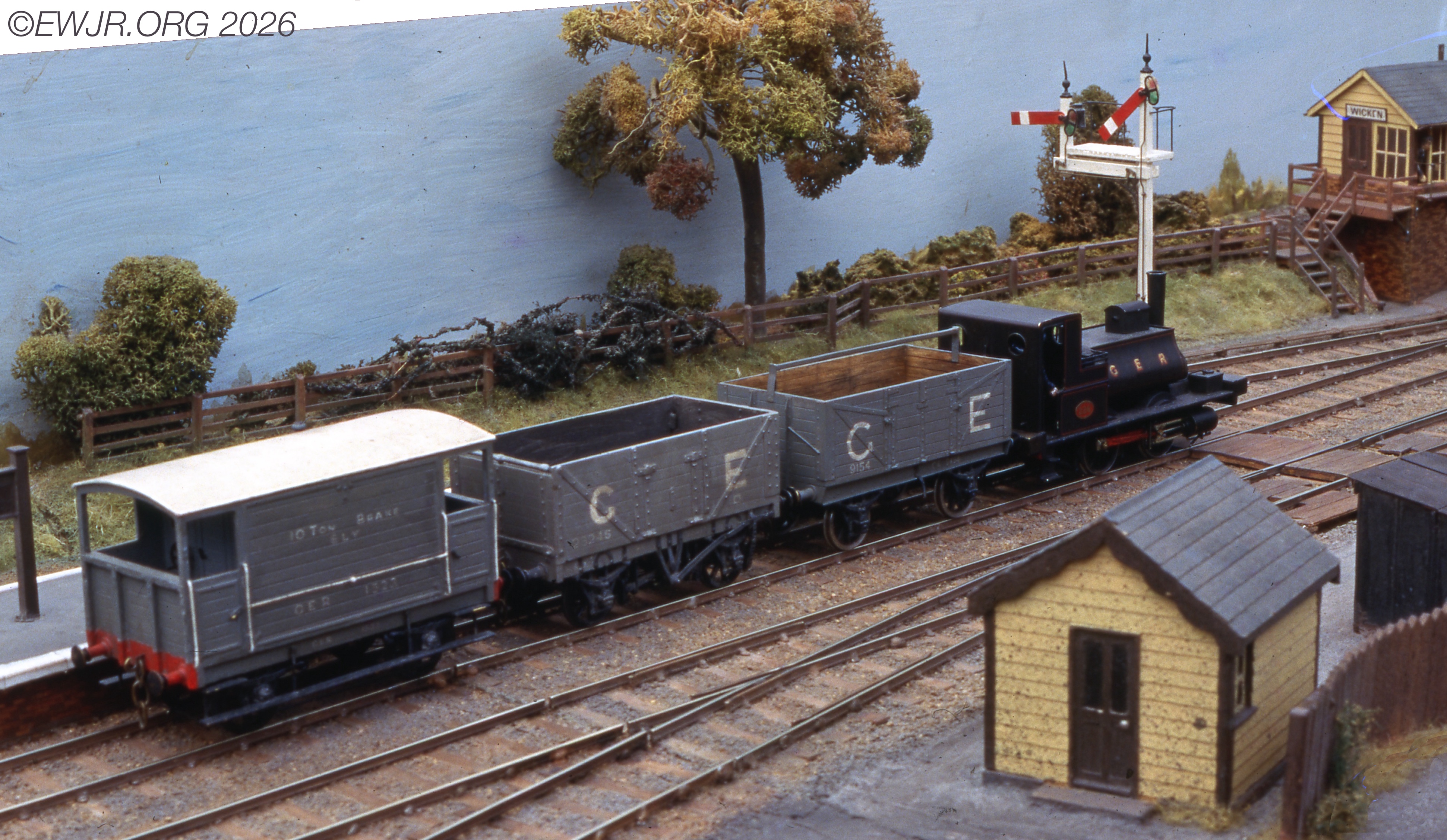
The layout did evolve over time: for example, the tramway was at first a private siding that went directly into the fiddle yard (which at first was all of the final baseboard) but after the first exhibition, this became a tramway with a single siding with a turnout to a siding heading off the front edge of the baseboard (operated by trains pushing wagons to the mill). A few years later – early 1980s – the turnout was changed to run in front of the mill rather than off the baseboard, and there were now two sidings and an extra controller. Arriving trains had the loco at the front, and “running round” involved using a chain between the loco and wagon(s) with the loco going down one route and the wagons down the other of the turnout: great fun!


For some time, there were no signals, but these eventually appeared, followed by the point rodding (which appeared after the Wicken article was submitted to MRJ, but before it was published).
More Locos
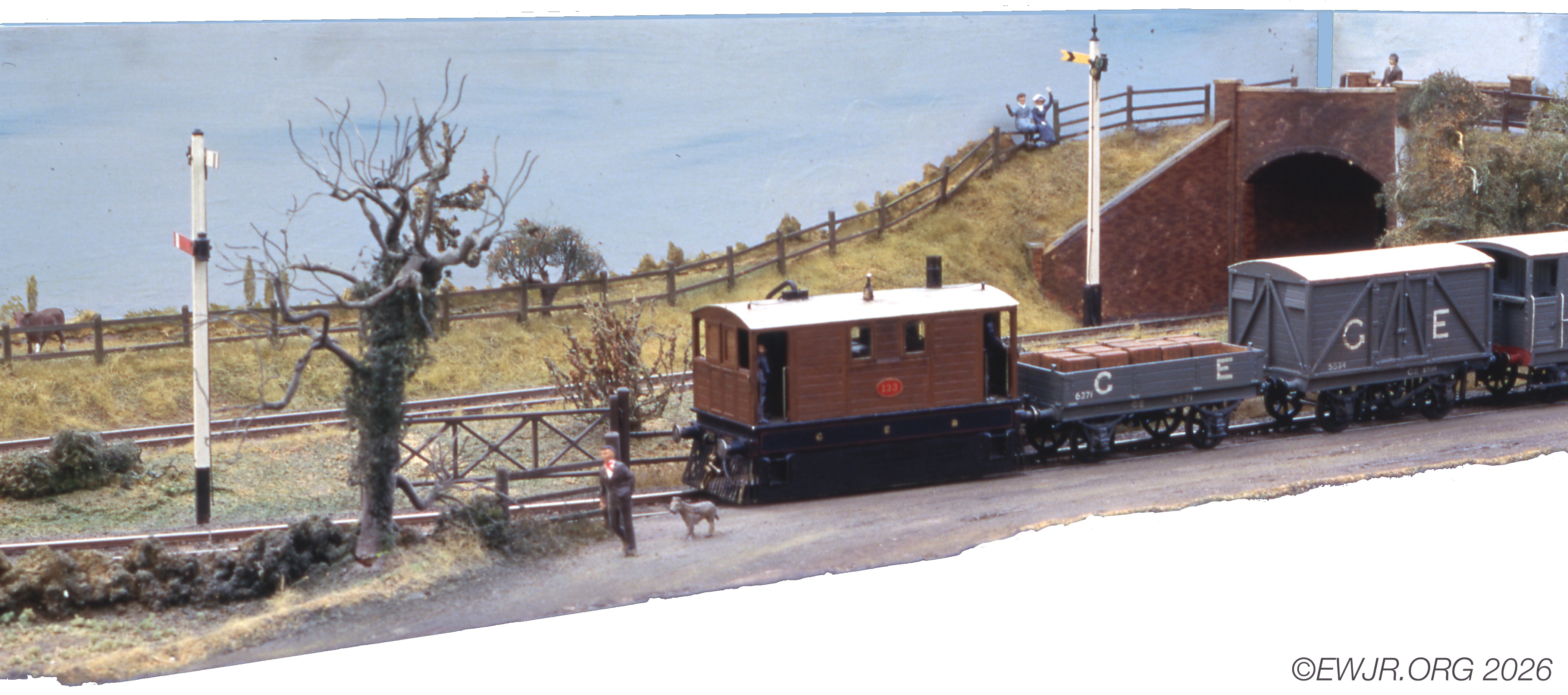
At first, there was no lighting, quickly changed to spots on a couple of poles, then finally overhead fluorescent tubes. But the basic format – four baseboards 42” x 16”, bolted face to face in pairs (with folding legs) for storage and transport – held true. Extra stock gradually accumulated, as hinted at above, but the E10 0-4-4T took nine years from start to finish, partly because it was needed less urgently (and see above pressures of moving house, etc) but also because Len White lent his S56 buckjumper then his N15 0-6-0T which were used on goods trains.

E10 with all of the passenger rolling stock!
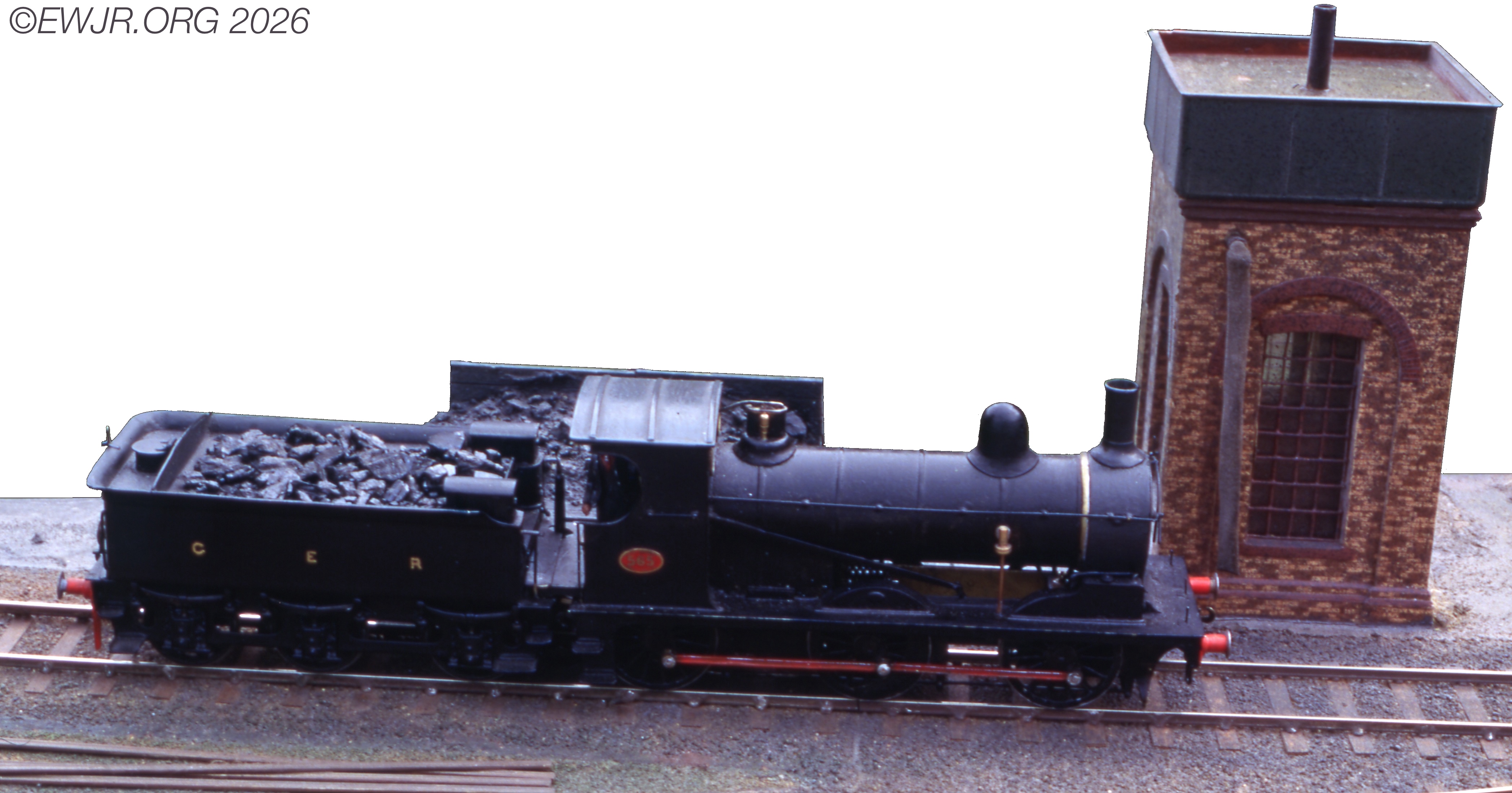
Later still (after the E10 was completed) Andrew Townley donated his No. 1 class “Sharpie” 2-4-0, which appeared at the final exhibitions.

The GER Passenger Train Cattle Box was from Jidenco etchings, resized for S.
The buildings used old Merco “smokey brick” paper over ply and balsa frames. The track was “ply and rivets” as its assembly – not as good as using chairs, so don’t look too closely! There wasn’t much room for scenery, but there was a surprising variety. There was an attempt at representing boggy ground using gloss varnish. At one exhibition, a friend’s wife was heard commenting absent-mindedly that someone had sneezed on the layout, to much hilarity.

Last Rites
Work on East Lynn started in 1993, and it had a “shake down” test at the Leicester MRG exhibition in September 1995 – largely with just the stock from Wicken – followed by an “official debut” at the “Scale Show” in October 1996 (S Scale MRS 50th anniversary – we had changed name by then) where more wagons and some coaches in shiny zinc appeared. By this time, Wicken had been retired and the signals and building retrieved: the granary and the water tower were reworked and still inhabit East Lynn, the signal cabin appeared on Sulgrave Manor, but is now – along with the station building – in the care of a collector. The layout itself was given to a fellow member of SSMRS, who stored it – carefully wrapped – in his loft, a loft which had previously held his own layout. But alas, an insect of some kind found the insulation board used for the baseboard surfaces to its liking, and ate rather a lot of it. Sic trainset gloria mundi!