Category Archives: Modelling

Modelling activities

Intelligent Discussion

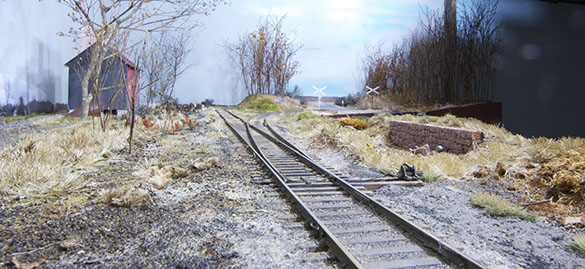
Unless you have stumbled upon my blog for the first time, Mike Cougill will be no stranger to you. As I have said before, the thoughtful postings on his blog have helped pull me out of my modelling doldrums more than once. And not because he gave me answers, either – not even because he gave me questions – but because he guided me to ask myself the right questions. Mike is very well read on matters such as “thought leadership”, which is not as nebulous a phrase as many might think – see my previous sentence about guiding someone to asking themselves the right questions – and has identified a niche in the model railway hobby for thinking. If you want to see how this operates, then have a browse at the excellent O Scale Trains Magazine website (out of print back-numbers are free), and read his column in issues 37, 38 and 39. If you like what he wrote there, you will enjoy the rest of his output, which produces such scenes as this:

Still life with gold bricker Still life with gold bricker

Modelling Masterclass

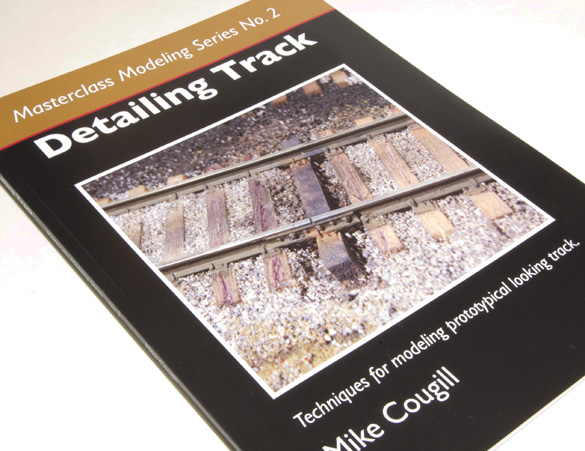
Under the series title “Masterclass Modelling”, Mike has published 2 books so far: the out of print “Pieces of the Puzzle” and the sublime “Detailing Track”. An e-book on Covered Hoppers, Volume 1 of a promising series on modern freight cars, has also appeared and provides detail photos that every modeller of these vehicles need. I don’t model these vehicles, but being fascinated by the prototypes, I bought it and learned quite a lot in the process!
“Pieces of the Puzzle” was Mike’s first venture into publishing, and as he admits, was a “learning experience”. It is now out of print, but Mike feels that issues 1 and 2 of The Missing Conversation make a fuller and clearer exposition of his thoughts on this title. I will review this no further, except to say that I really enjoy re-reading it.

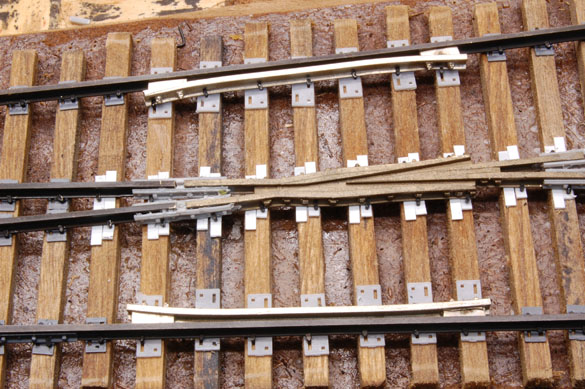
If you want to learn how to achieve this, then the book is for you. If you want to learn how to achieve this, then the book is for you.

“Masterclass Modeling Series® #2 -Detailing Track” is a masterpiece worthy of a much wider audience in the hobby. Here is a book which deals with the prototype and how to model it, and is written for a discerning audience. How discerning? Well, if you wish to model track rather than simply lay track and ballast and paint it, then you are discerning enough to buy the book, and you will not be disappointed. It is profusely illustrated, informative, and helpful. Mike’s aim is to encourage modellers to “take the first step toward making that dream of a railroad in your mind a reality”, and this he does via the simple 3 stage process of outlining the design and use issues for the prototype, how these might be modelled, and then he actually does this, step by step. For a flavour of Mike’s approach, read this blog posting, and learn how to start producing work such as this:

“Hand laying turnouts isn’t hard. Getting over your reluctance and internal fear is the hardest part.”

I would have liked a bit more information on track from 100 years ago, when things were less standardised, and more generally on the placement of switch stands, but if you think track is a model in its own right and a key component of the whole modelling scene, then this book is for you, regardless of the country, period and prototype of your modelling, and I would advise that you order it now!
On page 46, Mike offers the best piece of advice I have ever seen, not just about modelling track, or indeed about modelling: stop before you go too far. (In this context, do not file too much off, do not over-detail.)

The Missing Conversation

Having identified a gap in the market for “folks looking for an in-depth discussion about the hobby” Mike has created The Missing Conversation with the simple aim of speaking to this “deeper, more thoughtful” audience. The Missing Conversation is built on three basic principles, which are fundamental to Mike’s approach to the hobby:

A scale model should be consistent from top to bottom, including the wheel profile and track gauge.

If the hobby is worth doing, it is worth doing well.

Details matter.

Apart from the publisher’s piece on the “back cover” (it is not a book, but a pdf) there are no distracting adverts. There is also no letters page – the OST blog serves this function, after all, and provides a forum for the conversation. The layout of the book is clean, simple, and elegant, including a reasonable amount of “white space”. The latter is important, as any student of Japanese art will tell you. It creates in this case “thought space”, i.e. it encourages thinking. There is no visual crowding to be carried over into the mind, so there is space to think. Reading The Missing Conversation is not to be hurried. Like good poetry, it repays careful thought about the phrases used, even the very words – and like good poetry, it can also be enjoyed as a leisurely read in its own right. It is not for everyone, I admit, but personally I think it is worth every penny. So far, The Missing Conversation has had the following issues:

Volume 1 – Layout Design: Asking why instead of how
Volume 2 – The Essentials
Volume 3 – Standards. Finescale standards in Proto:87 and Proto:48, with a feature on Warner Clark’s outstanding Proto:48 layout
Volume 4 – Craftsmanship. Featuring the work of Tony Sissons in 1:87 and Tom Mix in 1:48.
Volume 5 – Switching: More than meets the eye. Operations from the perspective of real railroaders.

There are also two free special editions, Starting in Scale Modelling and Questioning Normal, and Mike has produced two useful short introductory pieces on track, Handlaid Track and Turnouts, which are free to download and disseminate (which is what I have done here).

In short, if you want someone to tell you what to think, Mike’s published output is definitely not for you. But then, if that was the case, I doubt if you would have read this far. Would you enjoy The Missing Conversation? I cannot say, but download the free articles, and if you enjoy them, you can ask yourself the correct question!

The Missing Conversation provides thought leadership for the hobby.

Pictures reproduced with kind permission of OST Publications.

Threads

Mike Cougill’s recent post on the positive impact of removing track from his layout has led to some interesting debate, as well as a stunning photo. It has, as usual, got me thinking, and thinking about the opportunities different scales offer for different types of authenticity. I may be repeating some of several previous posts, but the threads are drawing together, and who knows, I may spend less time thinking and more time modelling soon?

The late Don Boreham, who was an inveterate and excellent narrow gauge modeller as well as long time secretary to the Model Railway Club in London, wrote in his book on Narrow Gauge Modelling that “perhaps the best scale to use is the largest one has space for”.

I like that phrase as it is rather subtle. Does it mean we should all work in 1:32, for example?

Not at all, but it does suggest that 1:32 is great for modellers who are interested in modelling items of rolling stock, rather than operations. Similarly, if one is driven to recreate the impression of trains in the landscape, then a smaller scale is indicated. In the first case, a coach or locomotive is the defining feature of modelling. In the latter case, the defining feature is train, or perhaps even train-in-landscape.

I personally find smaller scale layouts more impressive if they are placed in a relatively large space. It’s not that I am not impressed nor interested in the quality of fine detail and engineering in N gauge, for example, it’s simply that what impresses me is a train moving smoothly and deliberately through the scene: without quality engineering applied to mechanisms, there is no realism.

With larger scales, the individual models become the focus and there may not even be a scenic setting – being pulled by a model steam engine on an outdoor elevated track, the realism is about the authenticity of the motive power, the smell, the sounds, and the engineering. But again, a well engineered model will run well and be more authentic. Sorry to some of the “live steam” guys, but slip-eccentric valve gear requiring a manual push to set it doesn’t really do a lot for me.

I personally think that 1:32 is about as small as the “model engineering” approach can go, and also about as large as the “modeller” can go. In between, we have a continuum from Z scale up to 1 scale, maybe even larger for narrow gauge (15mm scale on 45mm gauge track, for example). Anyone with a large basement and an inclination to replicating operations will obviously find 00/H0 or possibly N ideally suited to their needs, as they require a large number and variety of robust models. The realism here is about authentically replicating a number of “railroad jobs”.

I think S possibly chose me, rather than the other way round, but it is the largest scale I can fit into my available space, and I like making things, so it suits me very well. (I have tried other scales, but always return to S.) Mike has a bit more space than I, and obviously derives great enjoyment from modelling the fine details, so 1:48 suits him well. If I had more space, maybe I would model in a larger scale, too: what I want is to build models to a high level of detail, and then to move them about in a purposeful manner, replicating real railway movements and operations. I need sufficient space for a layout of a station or a yard, tempered with the largest size models I can get into that space.

The interesting thing, of course, is that to be effective, all of these approaches require reliable engineering as anything else destroys the realism, but as the scale gets bigger (in terms of the model size, rather than the number used!) the focus begins to shift from quantity of operation to quality of operation. This does not make either of these “better” than the other, merely reflects the preferences of the individual. Rather than work against a sped-up clock to get a train rapidly sorted and on its way, I want to concentrate on the individual stages involved in coupling up: approach slowly, stop short, inch up, connect pipes (if required), pull back and place with other vehicles. I wouldn’t have time to model these niceties if working a large sorting yard against the clock: maximum use would be made of automatic coupling facilities: engines would still approach carefully, but they would not stop in advance of coupling up, nor would they pause for pipe connections to be made and (if necessary) automatic brakes tested. I am more interested in the operation of a train, than operating trains. Others differ – and wouldn’t life be boring if they didn’t?

Where anyone sits, is entirely up to them, as is where they judge the competing aims and advantages of different scale to meet and overlap, but I put it to you that unless you have the right balance and blend, you will be unhappy in your modelling.

If you are, then very good.

Makes you think…

As some of you will know, I have become a regular contributor to discussions on Trevor Marshall’s Port Rowan blog and Mike Cougill’s OST Publications blog. Both of these can be found via my links section (to the right for most computers, but to the bottom on tablets).

It was stumbling across the thought processes which led to Trevor’s Port Rowan layout, via the S Scale SIG forum (I am active there, too, but you need to register as a member to read it) that got me out of my modelling doldrums and frankly gave me the slap across the face that I needed to make me realise that it is possible to combine something like the ramshackle emptiness of the Bishop’s Castle Railway with North American prototypes. This re-awakened my long-standing interest in the short lines owned by the Central of Georgia, which has been further strengthened by reading around the subject, and making contact with Steve Flanigan, who models the Louisville and Wadley in H0 in a small space and has shared the fruits of his personal research with me. But then, he is North American, and what are North Americans for, if not generosity?

What Trevor has really done, though, is to take operations in a slightly different direction from what seems to be the norm in North America, based on magazines and websites.

Instead of trying to run as many trains as possible over a large basement empire with multiple stations, based on use of waybills and timetable and train orders (TTO) and a dispatcher, etc., he has concentrated on the individual operations around running the daily mixed train. This includes pausing to pump up the air, align couplers, connect hoses, etc. An out-and-back turn can take up a couple of hours, after which there seems to be a visit to a local hostelry for good food and decent beer. OK, this isn’t everyone’s cup of tea, but it is my pint of ale!

On top of this, we get superb modelling (on a par with Barry Norman and Maggie and Gordon Gravett) and a generous sharing of ideas and techniques. Well, he is Canadian, and what are Canadians for, if not politeness?

Mike’s forum is subtly different.

The same basic theme is there, that you don’t actually need a lot of layout to have a lot of fun. You get the fun by trying to model everything as faithfully as you can – the joy is in the detail.

Mike has published some booklets and books and also “The Missing Conversation”, which will form the subject of another post, but he also makes a though provoking post each week on various aspects of the hobby. He has also been editor of O Scale Trains, and a regular columnist on finescale matters in that magazine. What I like about Mike, or to be more accurate one of the many things I like about Mike, is that he has taken a stand on behalf of Proto: modelling. I have always hinted at this (and not very covertly), but knowing that I am not a lone voice means I take that stand too – albeit feeling slightly ashamed for not having taken it more clearly sooner. Well, I am English, and what are Englishman for, if not self-deprecation?

More importantly, Mike has generously provided, via his blog, a forum for intelligent, thoughtful conversation. My experience of Americans has always been positive and I wish some of their modern politicians were more careful about the impression they create on the world stage (but then, they are politicians, and what are politicians for if not promoting their own importance?)

I realise that for many people, a hobby is about getting away from thinking, but I am not mindless and I enjoy having my thoughts provoked. In the case of these three gentlemen, it has been to open my mind to what was lurking away at the back of it, and get me more interested in modelling than I have been for some time.

Thanks, guys!

If you have been planning to, well, go on then.

Instant Gratification

I couldn’t possibly do that.

If you frequent forums, exhibitions, clubs – in short, if you socialise in any way whatsoever within the hobby – then you will be familiar with this comment. You may have even made it yourself. I know I have thought it, if not said it out loud. Whilst I agree that many things seem daunting at first, and that this can be a valid initial reaction, I have to say that the phrase is poppycock!

I have had, so far, a varied and interesting professional life which has exposed me to many different industry sectors and companies. One company where I have worked had its offices peppered with motivational slogans, in a manner that an American friend once described as, “Very ‘Corporate America’, even for an American”. Two of their slogans struck a chord, such that over a dozen years later I can still recall them. One of them was about not rushing things (see enlightened impatience!) and was abbreviated to “TTT” – Think Things Through (thankfully it wasn’t abbreviated from think it through, as the slogan was liberally distributed above people’s desks!) The other was about maintaining the right attitude:

“If you think you can, or think you can’t, you are probably right.”

Put another way, if you have decided that you will fail, then fail you will, but if you are determined, then you will succeed. I have a favourite quote from the wonderful Jane Goodall, “If you really want something, and really work hard, and take advantage of opportunities, and never give up, you will find a way.” And that is what this post is about – wanting something enough.

There are a few, very few, modellers who seem to just get things right from day one, in the same way that some people can just pick up a musical instrument and play – I am thinking of the Mozarts and Hendrixes of this world. For the rest of us, we have to work hard. Not every musician can play by ear, even those who make a living from it. Francis Rossi of the Status Quo practices scales on his guitar for two hours a day, to make sure he doesn’t lose his touch. Roger Daltry tells a story about the first time he saw Jimi Hendrix, in the company of Eric Clapton (messrs Daltry and Clapton are both railway modellers, by the way). On the way back from the gig, Clapton apparently murmured that he was going to go home and practice some more. Daltry’s comment on this is, “I’d hate to be a guitarist.” And that’s the point: it takes work, even if you have talent, to be really, really good. And although, as anyone who has played one will agree, an expensive, quality guitar is easier to play, you don’t need an expensive tool of the trade to start with. Pete Townsend leanred to play on a cheap guitar, using a old sixpence coin as a plectrum, and ultimately learned to play on just two strings as he couldn’t afford new ones when the others broke. In short, he learned to use what he had to hone his own abilities because he wanted to get better at playing the guitar.

It took me 15 years of half-hearted practicing to get to a point where I was happy with my own playing. Most people who play tend to do this rather more quickly, as they are rather more driven than I was, but the point is that it took time, effort and practice. I am not talking about being good enough to play on the stadium circuit, just good enough for me to feel comfortable (I have played in a couple of pubs, way back when – way back when I was awful!) I also worked my way through various guitars, culminating in one which I obtained at a considerable discount as it was shop-soiled (it had fallen off the display rack!) I mention this as it is frequently possible to buy a decent machine tool second-hand for less than the cost of something new but not as good.

Let’s turn this back to railway modelling…

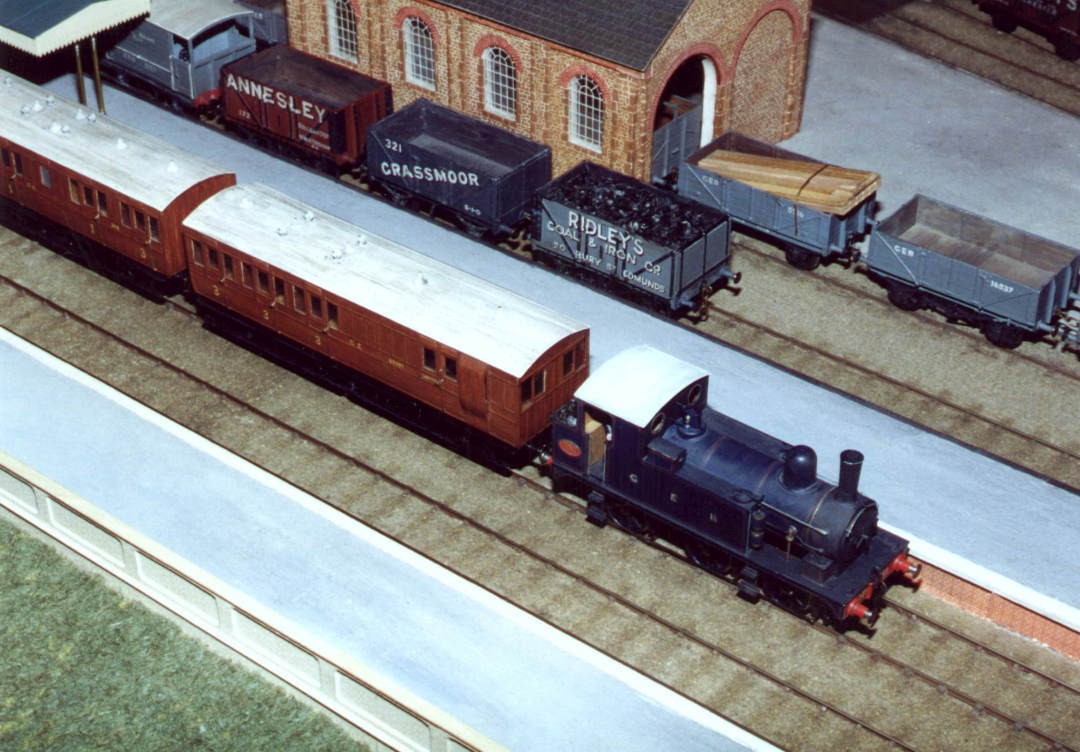
Iain Rice has made reference to his early years, with a loco repainted with “yard-high lettering”, and an amusing aside that we have all got to start somewhere. My good friend Trevor Nunn, whom I would dub the “compleat railway modeller”, builds virtually everything himself, with many of the castings he used having been produced from his own patterns. But he didn’t start out scratch building locos with working inside motion. No, he started out as a teenager with a simple Stewart-Reidpath kit, which he modified to look similar to a Midland and Great Northern Joint Railway 0-6-0 tank loco. During the sixties, he started to build whitemtal kits and modify ready to run locomotives to represent other classes, such as converting a Triang M7 into an LNER G5. The Bury St. Edmunds club members frequently benefitted from this (he was heavily involved with them at the time, including designing the Abbotsford terminus) and as he improved his skills, confidence and familiarity with tools and materials, he progressed to scratchbuilding. His remarkable finescale 00 models of an LNER E4 2-4-0 and B1 4-6-0 now belong to Ray Hammond – who was also a member of the same club (along with, at various times, other noted luminaries as Jas Millham and Barry Norman – what a club!) He was about to embark on a model of the LMS Ivatt 2MT 2-6-0 when he came across S scale in the early 70s – by this time he was in his mid-30s – but for many years he had only two Great Eastern Railway locos of his own: a G15 (LNER Y6) 0-4-0T tram loco, based around a Triang motor bogie with body of metal and wood, and a 209 class (LNER Y9) 0-4-0ST. The Wicken branch’s staple loco, the E22 (J65) 0-6-0T did not appear until 1980, and the next loco, an E10 class 0-4-4T, was started in 1982 but took 9 years to complete. Since then, he has built two new layouts including the buildings and track, coaching stock, wagon stock, and many new engines, but the point is that he wasn’t born able to do this. Although I think he is blessed with an innate ability to handle a file well (which I would rate as the most important skill to have) he had to serve his time and put in his modelling apprenticeship, interrupted as it was by National Service, starting a career, getting married, starting a family, etc. These didn’t just absorb time, they absorb money, so he learned to make do, and to make.

But this wasn’t an “overnight success” story, although I think all would agree that it was a success. It took many years. And at the end of this period, he felt confident to tackle new projects, to push his own boundaries. As an example, when he built his G16 4-4-0, he was aware that the high-pitched boiler left a rather obvious visible space between the frames, a space which on the real thing was filled with piston rods, slide bars, connecting rods and Joy’s valve motion. He had never done this before, and did contemplate having dummy, non-working, motion. Thankfully this contemplation was brief, and he resolved to have a go, and make it work. It took a surprising amount of time to get all the required details together, but the finished model is a work of engineering art, and the motion a joy to behold (see what I did there?) with links moving above and below the plate frames. Since then, of course, more locomotives have been built with working inside motion, and Trevor has come to the conclusion that with Stephenson link motion, the movement is so small and subtle that whilst it is worth making the connecting rods, etc, move, the actual valve gear could be static. One problem now remains – what of the older engines, built before he decided to try pushing his boundaries? Well, some of them would benefit from the addition of extra detail, for example the above mentioned E22 tank loco would benefit from some slide-bars filling out the space, some from moving motion, and others such as the E10 and his D27 2-2-2 single wheeler have things like sandboxes and splashers positioned such that nothing is required (given the drive arrangements, this is a good thing, as it would an interesting technical challenge!) And by the way, the locos have split-axle pickup, with all metal wheels using lost-wax brass castings for the centres, turned to fit into steel tyres which are profiled on the lathe. Apart from the actual casting process, all of this – including making the patterns – is done by Trevor himself: when he had built up enough skill and confidence, and not before, he bought himself a lathe, and taught himself how to use it.

And this takes us back to the title: instant gratification. It is a sad observation of modern life, but as we have become more affluent as a society, we seem to have developed a desire to purchase, rather than to make – to buy things ready-made, rather than to buy the tools to make things, and to expect everything to be right. In short, we look for instant results, and instant gratification. I have found that generally speaking, instant gratification only lasts for an instant, and that for anything to be valued, it needs to come as the result of hard work. And the longer that takes, frequently the greater the personal satisfaction, which is much, much better than gratification.

So, to be good takes time. And effort. And determination. And care. And for most of us, starting off with a basic toolkit, and with simple techniques is the start of this. Replacing moulded details such as handrails with wire is a great start: sadly the manufacturers often do this for us now (but sometimes the effect is a bit heavy and overscale and therefore it is worth doing it yourself). So is upgrading components, for example with “after market” parts, or making a few pieces yourself. Moving on, good kits are a great thing (I learned a lot about North American freight cars from building PRS boxcar kits) and then one can look at modifying RTR and kits into new variants. Beyond that, scratchbuilding calls, and the world is the mollusc of one’s choice. But it won’t happen overnight. It takes time, and effort. But it is massively rewarding: something you can only find out by having a go.

If you didn’t, why not?

Water fowl of the family anatidae – recumbent or otherwise

Hobbies are ways to unwind, to shut off the outside world and its worries. So surely they should not be a source of trouble, yet they are. Have a look at most on-line forums – not just for model railways.

Why is this?

Well, I have lots of roles and even duties to fulfil in life. In no particular order, I am a son, father, employee, manager, uncle, nephew, etc but when I am modelling, I am none of these.

When I am modelling, I am me. Just me. No one else. I do it for me. I do it for my own enjoyment. We all do. No point doing it otherwise.

Hobbies are what we do, when we want to be ourselves. 

This is why they are important to us.

This is why it is easy to get hot under the collar – if someone criticises my approach to the hobby, they may not intend to, but they are criticising me, so I will react.

I get immense personal enjoyment from making things well – accurate representation not just of the real thing, but how the real thing moves, as far as the immutable laws of physics permit with a scale model. I cannot understand why anyone would settle for less, and it amazes me when they do, but many do. They seem to enjoy themselves, so I have learned to let it go.

I frequently see nonsense about miserable finescalers being posted on-line in forums and on-line magazines, published in letters columns, or espoused loudly at model railway shows. Why do some people swoop so low as make a wide-sweeping, and wide of the mark, generalisation? (I am aware that any generalisation is likely to be wide-sweeping, but please forgive the tautology on the grounds that I am at least being consistent.) When I see those who espouse a tighter tolerance on authenticity being called “elitist”, I am amazed. You see, I know quite a few people in the hobby, and the best modellers are also the best people. They are not only happy to share in their techniques, but to provide friendly encouragement. They might be the elite, but elitist? That would involve not sharing. That would involve putting down other people’s efforts. No. That’s not them.

The problem is, it might quack like a duck, waddle like a duck, and actually be a duck (rather than a swan or goose), but that’s not the point – what species of duck is it? Simply painting the tail black doesn’t turn a female Mallard into a female Gadwall: apart from the latter being smaller, there are other differences, too. But to many modellers, a duck is a duck is a duck. If you are one of those, then good luck to you: your modelling life will be less complicated, and you will have fewer hurdles to jump. I personally think you will get less personal satisfaction out of this approach – in every aspect of life – but will not force how I enjoy my hobby on you.

I you prefer pictures, then I think it has been very eloquently put by Rene Gourley on his Proto:87 blog, with his simple game of “spot the difference”. I suspect that if you can’t spot the difference, or if it doesn’t bother you, then it is unlikely that you have visited this blog before. I really hope, though, that I am not simply preaching to the converted.

If you have been, well, I suppose you must.