
The word “finescale” is often banded about in model railways, without any clear meaning and sometimes as a term of abuse. As far as I am concerned it has a fairly simple definition:
“Making models look more like the real thing.”
That’s it. Proportion, shape, colour and texture are what it is about. Finer track standards and fine detail are a consequence of this approach, not the driver of it.*
Proportion and shape are closely related, of course, but essentially if a model doesn’t “capture the essence” of it’s subject matter, then no amount of work on fine details, etc, will redeem it.
Colour needs to reflect the muted effects of the atmosphere: muted, slightly duller (satin instead of gloss, everything else matt or dull) and considered use made of a restricted paint palette. Use of a “unifying tint” helps – I used to favour adding a drop of “BR coach grey” to all my tins of Humbrol paint.
Texture is less easily defined. Again, understatement is the key. It needs to be fine, not overdone. Sometimes this means using paint rather than anything else – dry brushing, for example, can suggest the texture of rust or Tarmac, as can careful use of weathering powders. In theory, a well maintained brick wall can be represented with brick paper: there is no way that the texture of the face or the mortar would show, if scaled down; yet the eye expects to see texture, so some form of embossing is essential, even if it is over scale! Oh well, there’s an exception that tests every rule…
Texture implies being careful about details, and it does mean finer track standards as they look more like the real thing, and more importantly when something moves, it moves more like the real thing, but the finer tolerances are a natural consequence of the approach.
I am also aware that for many people, this not of interest to them. I am OK with that: it’s a hobby and you get out of it what you will. And you are welcome to browse around the site and use any hints, tips, and ideas you pick up or develop by thinking how you would do it.
The other question is, is it worth it?
Well, that does depend on what you want from your hobby but if the picture below, courtesy of Barry Norman and taken during my dalliance with 1:32 finescale, is to your liking, then the answer is probably yes!
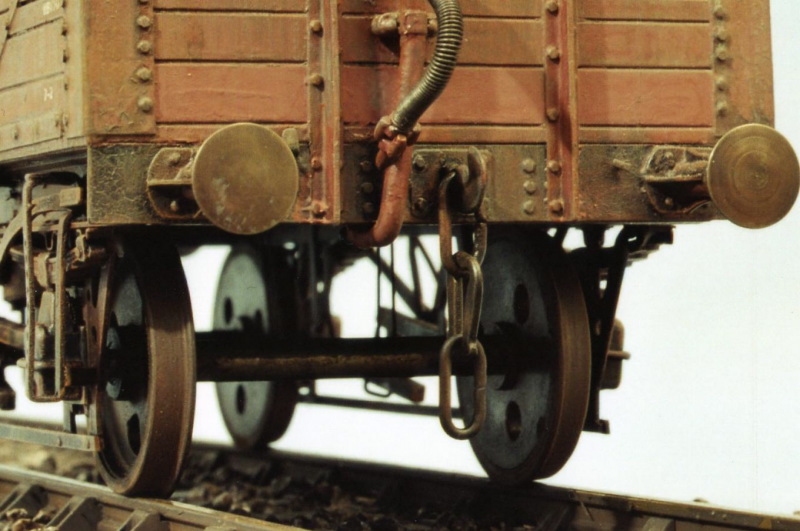
Most of what you see there is made from styrene sheet, yet the real thing was wood and metal.
*Of late I have come to the conclusion that the only way to make “00” “finescale” is to go to the EM “fine” standard, as used by Pendon Museum, Ultrascale, etc. Otherwise the proportions at the font end, and the placement of various track work features in turnouts, are simply out of kilter. Controversial? Not really: it’s simply a matter of being consistent. Working in S, this is not something I need to worry about, as we have a single set of standards derived from the prototype.

 The Erratic and Wandering Journey
You must be logged in to post a comment.