Elitism: in the mind of the accuser

Whilst driving to visit a model railway exhibition, I was listening to the radio. I always enjoy listening to “Desert Island Discs”: the format is superb, the host (Kirsty Young) perfect for the role, and the guests are varied and interesting (although sometimes, not quite how they think they might be interesting!) The guest on Sunday 26 May, 2013, was the dancer Deborah Bull. Now, I will be honest: ballet and dance, like opera, are not my bag – but I suspect my life is the poorer for not really understanding them. However, it is always interesting to listen to someone who is among the best in their chosen profession.

It was an interesting and pleasant interview, but about two thirds of the way into the programme (round about 32 minutes if you wish to jump to the relevant part of the podcast), Ms. Bull said something which really caught my attention, in response to a gently provocative question about funding for what is seen by many as an “elitist” art-form:

“Arts are practiced by elite artists, but are not intended for an elite group of people… …Everyone has the right to expand beyond their immediate horizons.”

Wow!

I don’t like the use of the word “right” in this context, preferring “opportunity”, but I have to say I agree wholeheartedly with her on this. It also applies to model railways. Just because my magazine of preference is the “Model Railway Journal”, just because I know some pretty outstanding modellers, just because I prefer to give honest feedback if someone asks for advice, in short just because I want to take the opportunity to be better and exchange ideas with others who wish to do this, doesn’t make me elitist.

I mean, why would anyone want to be a champion for mediocrity?

If you don’t, please do.

Instant Gratification

I couldn’t possibly do that.

If you frequent forums, exhibitions, clubs – in short, if you socialise in any way whatsoever within the hobby – then you will be familiar with this comment. You may have even made it yourself. I know I have thought it, if not said it out loud. Whilst I agree that many things seem daunting at first, and that this can be a valid initial reaction, I have to say that the phrase is poppycock!

I have had, so far, a varied and interesting professional life which has exposed me to many different industry sectors and companies. One company where I have worked had its offices peppered with motivational slogans, in a manner that an American friend once described as, “Very ‘Corporate America’, even for an American”. Two of their slogans struck a chord, such that over a dozen years later I can still recall them. One of them was about not rushing things (see enlightened impatience!) and was abbreviated to “TTT” – Think Things Through (thankfully it wasn’t abbreviated from think it through, as the slogan was liberally distributed above people’s desks!) The other was about maintaining the right attitude:

“If you think you can, or think you can’t, you are probably right.”

Put another way, if you have decided that you will fail, then fail you will, but if you are determined, then you will succeed. I have a favourite quote from the wonderful Jane Goodall, “If you really want something, and really work hard, and take advantage of opportunities, and never give up, you will find a way.” And that is what this post is about – wanting something enough.

There are a few, very few, modellers who seem to just get things right from day one, in the same way that some people can just pick up a musical instrument and play – I am thinking of the Mozarts and Hendrixes of this world. For the rest of us, we have to work hard. Not every musician can play by ear, even those who make a living from it. Francis Rossi of the Status Quo practices scales on his guitar for two hours a day, to make sure he doesn’t lose his touch. Roger Daltry tells a story about the first time he saw Jimi Hendrix, in the company of Eric Clapton (messrs Daltry and Clapton are both railway modellers, by the way). On the way back from the gig, Clapton apparently murmured that he was going to go home and practice some more. Daltry’s comment on this is, “I’d hate to be a guitarist.” And that’s the point: it takes work, even if you have talent, to be really, really good. And although, as anyone who has played one will agree, an expensive, quality guitar is easier to play, you don’t need an expensive tool of the trade to start with. Pete Townsend leanred to play on a cheap guitar, using a old sixpence coin as a plectrum, and ultimately learned to play on just two strings as he couldn’t afford new ones when the others broke. In short, he learned to use what he had to hone his own abilities because he wanted to get better at playing the guitar.

It took me 15 years of half-hearted practicing to get to a point where I was happy with my own playing. Most people who play tend to do this rather more quickly, as they are rather more driven than I was, but the point is that it took time, effort and practice. I am not talking about being good enough to play on the stadium circuit, just good enough for me to feel comfortable (I have played in a couple of pubs, way back when – way back when I was awful!) I also worked my way through various guitars, culminating in one which I obtained at a considerable discount as it was shop-soiled (it had fallen off the display rack!) I mention this as it is frequently possible to buy a decent machine tool second-hand for less than the cost of something new but not as good.

Let’s turn this back to railway modelling…

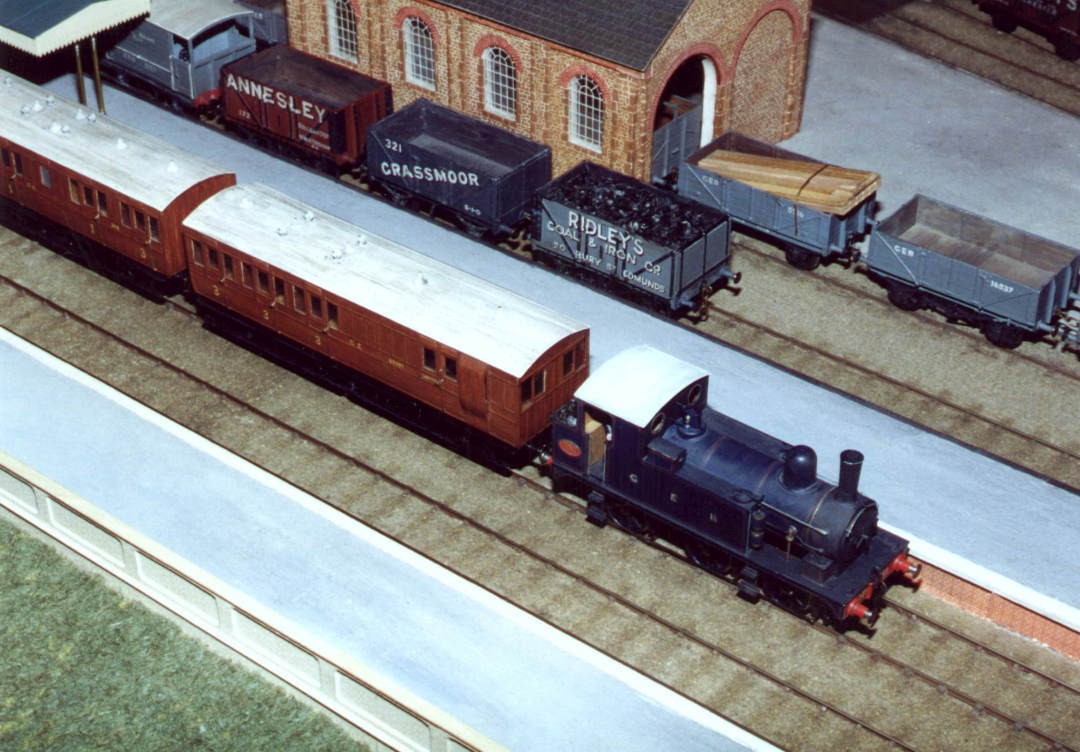
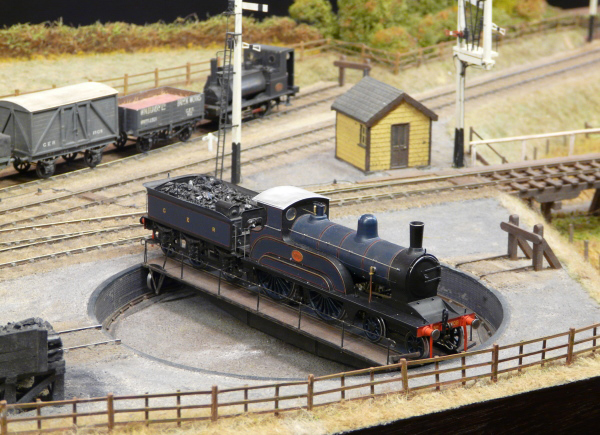
Iain Rice has made reference to his early years, with a loco repainted with “yard-high lettering”, and an amusing aside that we have all got to start somewhere. My good friend Trevor Nunn, whom I would dub the “compleat railway modeller”, builds virtually everything himself, with many of the castings he used having been produced from his own patterns. But he didn’t start out scratch building locos with working inside motion. No, he started out as a teenager with a simple Stewart-Reidpath kit, which he modified to look similar to a Midland and Great Northern Joint Railway 0-6-0 tank loco. During the sixties, he started to build whitemtal kits and modify ready to run locomotives to represent other classes, such as converting a Triang M7 into an LNER G5. The Bury St. Edmunds club members frequently benefitted from this (he was heavily involved with them at the time, including designing the Abbotsford terminus) and as he improved his skills, confidence and familiarity with tools and materials, he progressed to scratchbuilding. His remarkable finescale 00 models of an LNER E4 2-4-0 and B1 4-6-0 now belong to Ray Hammond – who was also a member of the same club (along with, at various times, other noted luminaries as Jas Millham and Barry Norman – what a club!) He was about to embark on a model of the LMS Ivatt 2MT 2-6-0 when he came across S scale in the early 70s – by this time he was in his mid-30s – but for many years he had only two Great Eastern Railway locos of his own: a G15 (LNER Y6) 0-4-0T tram loco, based around a Triang motor bogie with body of metal and wood, and a 209 class (LNER Y9) 0-4-0ST. The Wicken branch’s staple loco, the E22 (J65) 0-6-0T did not appear until 1980, and the next loco, an E10 class 0-4-4T, was started in 1982 but took 9 years to complete. Since then, he has built two new layouts including the buildings and track, coaching stock, wagon stock, and many new engines, but the point is that he wasn’t born able to do this. Although I think he is blessed with an innate ability to handle a file well (which I would rate as the most important skill to have) he had to serve his time and put in his modelling apprenticeship, interrupted as it was by National Service, starting a career, getting married, starting a family, etc. These didn’t just absorb time, they absorb money, so he learned to make do, and to make.

But this wasn’t an “overnight success” story, although I think all would agree that it was a success. It took many years. And at the end of this period, he felt confident to tackle new projects, to push his own boundaries. As an example, when he built his G16 4-4-0, he was aware that the high-pitched boiler left a rather obvious visible space between the frames, a space which on the real thing was filled with piston rods, slide bars, connecting rods and Joy’s valve motion. He had never done this before, and did contemplate having dummy, non-working, motion. Thankfully this contemplation was brief, and he resolved to have a go, and make it work. It took a surprising amount of time to get all the required details together, but the finished model is a work of engineering art, and the motion a joy to behold (see what I did there?) with links moving above and below the plate frames. Since then, of course, more locomotives have been built with working inside motion, and Trevor has come to the conclusion that with Stephenson link motion, the movement is so small and subtle that whilst it is worth making the connecting rods, etc, move, the actual valve gear could be static. One problem now remains – what of the older engines, built before he decided to try pushing his boundaries? Well, some of them would benefit from the addition of extra detail, for example the above mentioned E22 tank loco would benefit from some slide-bars filling out the space, some from moving motion, and others such as the E10 and his D27 2-2-2 single wheeler have things like sandboxes and splashers positioned such that nothing is required (given the drive arrangements, this is a good thing, as it would an interesting technical challenge!) And by the way, the locos have split-axle pickup, with all metal wheels using lost-wax brass castings for the centres, turned to fit into steel tyres which are profiled on the lathe. Apart from the actual casting process, all of this – including making the patterns – is done by Trevor himself: when he had built up enough skill and confidence, and not before, he bought himself a lathe, and taught himself how to use it.

And this takes us back to the title: instant gratification. It is a sad observation of modern life, but as we have become more affluent as a society, we seem to have developed a desire to purchase, rather than to make – to buy things ready-made, rather than to buy the tools to make things, and to expect everything to be right. In short, we look for instant results, and instant gratification. I have found that generally speaking, instant gratification only lasts for an instant, and that for anything to be valued, it needs to come as the result of hard work. And the longer that takes, frequently the greater the personal satisfaction, which is much, much better than gratification.

So, to be good takes time. And effort. And determination. And care. And for most of us, starting off with a basic toolkit, and with simple techniques is the start of this. Replacing moulded details such as handrails with wire is a great start: sadly the manufacturers often do this for us now (but sometimes the effect is a bit heavy and overscale and therefore it is worth doing it yourself). So is upgrading components, for example with “after market” parts, or making a few pieces yourself. Moving on, good kits are a great thing (I learned a lot about North American freight cars from building PRS boxcar kits) and then one can look at modifying RTR and kits into new variants. Beyond that, scratchbuilding calls, and the world is the mollusc of one’s choice. But it won’t happen overnight. It takes time, and effort. But it is massively rewarding: something you can only find out by having a go.

If you didn’t, why not?

Water fowl of the family anatidae – recumbent or otherwise

Hobbies are ways to unwind, to shut off the outside world and its worries. So surely they should not be a source of trouble, yet they are. Have a look at most on-line forums – not just for model railways.

Why is this?

Well, I have lots of roles and even duties to fulfil in life. In no particular order, I am a son, father, employee, manager, uncle, nephew, etc but when I am modelling, I am none of these.

When I am modelling, I am me. Just me. No one else. I do it for me. I do it for my own enjoyment. We all do. No point doing it otherwise.

Hobbies are what we do, when we want to be ourselves. 

This is why they are important to us.

This is why it is easy to get hot under the collar – if someone criticises my approach to the hobby, they may not intend to, but they are criticising me, so I will react.

I get immense personal enjoyment from making things well – accurate representation not just of the real thing, but how the real thing moves, as far as the immutable laws of physics permit with a scale model. I cannot understand why anyone would settle for less, and it amazes me when they do, but many do. They seem to enjoy themselves, so I have learned to let it go.

I frequently see nonsense about miserable finescalers being posted on-line in forums and on-line magazines, published in letters columns, or espoused loudly at model railway shows. Why do some people swoop so low as make a wide-sweeping, and wide of the mark, generalisation? (I am aware that any generalisation is likely to be wide-sweeping, but please forgive the tautology on the grounds that I am at least being consistent.) When I see those who espouse a tighter tolerance on authenticity being called “elitist”, I am amazed. You see, I know quite a few people in the hobby, and the best modellers are also the best people. They are not only happy to share in their techniques, but to provide friendly encouragement. They might be the elite, but elitist? That would involve not sharing. That would involve putting down other people’s efforts. No. That’s not them.

The problem is, it might quack like a duck, waddle like a duck, and actually be a duck (rather than a swan or goose), but that’s not the point – what species of duck is it? Simply painting the tail black doesn’t turn a female Mallard into a female Gadwall: apart from the latter being smaller, there are other differences, too. But to many modellers, a duck is a duck is a duck. If you are one of those, then good luck to you: your modelling life will be less complicated, and you will have fewer hurdles to jump. I personally think you will get less personal satisfaction out of this approach – in every aspect of life – but will not force how I enjoy my hobby on you.

I you prefer pictures, then I think it has been very eloquently put by Rene Gourley on his Proto:87 blog, with his simple game of “spot the difference”. I suspect that if you can’t spot the difference, or if it doesn’t bother you, then it is unlikely that you have visited this blog before. I really hope, though, that I am not simply preaching to the converted.

If you have been, well, I suppose you must.

“S”electing a “S”cale

Taking up S scale as the chosen medium for railway modelling is not for the faint-hearted – I am not talking about collectors of American Flyer here, but those who want to create a finescale model railway. It is not, though, as daunting as it may seem. This is a recurring theme on the S Scale Forum, which if S scale interests you, you are strongly urged to join (it costs nothing, although donations towards the upkeep are welcome). I though it an interesting exercise to tabulate some reasons why S scale might be right for someone, and indeed, why it might not:

  • Although only 36% longer than H0, S has 2 1/2 times the volume and mass – things roll better;
  • S is only 3/4 the length of 0, requiring only 56% of the area;
  • There is a reasonable range of RTR and kits, as well as limited run brass, on which to build;
  • Because of this, there is scope for individualism via modifications and new paint schemes;
  • If you wish to model something off the beaten track, where kit-bashing and scratch-building will be essential, then the larger size is easier on the hands and eyes;
  • Large enough to see details and models yet small enough to fit a layout into a reasonable space;
  • An active, if sometimes disparate, social scene where everybody has the common interest of enjoying S scale.

Against that, there are some valid reasons not to get involved, and some less valid reasons:

  • “I want access to a large manufacturing base offering great variety at the lowest possible cost.” Can’t really counter that – if that’s what you want, then H0/00 or N are probably for you;
  • “I have a large circle of modelling friends, all of whom model in H0, and I like to host sessions where they run their trains on my layout.” OK, stick with that, then, but maybe do a little bit of S scale for a small module?
  • “I don’t have the skill to alter RTR and kits, or to build kits.” Skill comes from practice, and from not rushing things;
  • “I want as much landscape as possible, in a small space.” OK, then N is probably best for you!
  • “I want really big individual models” I am not interested in a layout.” Well, S scale is a good size for this – you can pick things up more easily than in larger scales, but it sounds like 1:48 or 1:32 may be a better idea.
  • “I have too much invested in another scale already.” That depends on how it is invested. If you are 70 years old, and have spent the last 25 years building up a large operational empire and it all works, then maybe now is not the time to rip it all up! However, if you simply have a cupboard full of kits and RTR, then selling off those kits which you may never build via eBay or friends could fund your first steps into S.
  • “Nothing is made in S.” Look around: starting with the S Sig website and the NASG, as well as the UK S Scale Model Railway Society for an example of an organisation which has used the facilities of a group to produce the necessary parts;
  • “I don’t like the size.” Fair enough.

As ever, it is always a personal choice, but for someone who doesn’t want to run with the herd, someone who enjoys a challenge, then I would say, S scale is ideal.

If you are not sure, I think you should.

Enlightened impatience

A discussion thread on Western Thunder about carrying on when things go wrong, had me wondering about impatience and comments made about 3 decades ago by Dave Rowe in the late, lamented “Model Railways” magazine.

Experience has taught me that as soon as I do something like break a drill bit due to rushing things, then it is time to stop. The reason is that I am getting impatient, and cutting corners. This kind of unenlightened impatience is a bad thing. Imagine you have spent 20 hours carefully crafting a model, and then rush a final cleaning up exercise intended to remove any remaining burrs by not using the right tool because it is somewhere in the tool box, and you can use the scalpel in your hand anyway. The result of this “short-cut” is that you gouge a big crevice right across the most relief-ridden face of the model. You now have two choices: repair the damage, or make it again. Either way, the “short-cut” from not spending 30 seconds looking for, say, your glass-fibre burnishing stick, has cost you several hours.

Enlightened impatience, however, is a good thing, and I use it all the time to make myself slow down just a little bit. Enlightened impatience means that in the above scenario, I will stop, put down the tool which will nearly do the job, and select the right tool. I spend 30 seconds, but gain several hours and really don’t miss the frustration I haven’t generated. Similarly, using a series of drills to progressively open up a hole rather than one final drill of the required size will produce a neater, cleaner and more accurate result. Backing-off when tapping holes, rather than forcing the tap, means it won’t snap – not only breaking the tool but also leaving part of it behind.

Enlightened impatience means reminding myself that if I slow down slightly, and take my time, I won’t end up remaking the piece, and I will get to my goal sooner.

Every really good modeller I know does not rush things, but works carefully and methodically, and gets the job done in a steady manner. Conversely, every time I see something which looks a bit “slap-dash”, conversation reveals the modeller to have been in a hurry to get things done.

Maybe the “secret” of finescale is simply an attitude of enlightened impatience? Or as the Latin motto has it:

Festina lente

If you are in a hurry, slow down…