Take as much inspiration as needed, but no more…

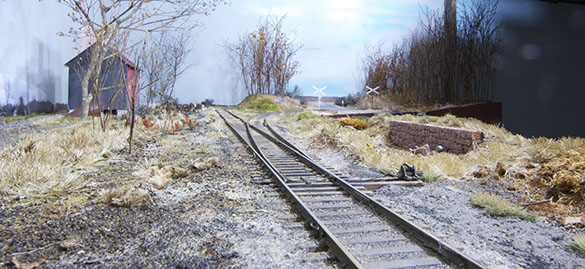
My attention was recently drawn (in the USA and Canadian Railroads section of RMWeb) to some frankly amazing modelling posted in the blog area of the Model Railroad Hobbyist site, the work of Stefan Foerg (diorama), Gary Christensen (cars) and Rodney Walker (engines):

Superb, isn't it?

The comment has been made that this is “(i)n some ways inspiring, in other ways it makes me want to give up and run screaming into the night“. It is inspiring in very many ways, but it does not put me off.

Any good modelling shows us what is possible, but the diorama builder apparently does do this for a living. Apart from the time he is able to devote to it, his skills are routinely and regularly practiced, so he will automatically be better at this than most of us. Like many things, skill is about practising and honing one’s abilities as much as natural aptitude.

What it does provide is the opportunity to re-assess our own priorities.

At one extreme in the hobby is the ultra-detailed small diorama, with everything just so but nothing moving. At the other might be the operating layout based on snap-track, or maybe flexi-track, where scenic details are scarce but enough to provide a background and purpose to operations, and equipment has come out of the box, but there is a focus on making sure that everything works well, so that the model can be operated in the manner of the prototype. Both of these require care in execution, if they are to fulfill their designer’s needs, but where that care is allocated and time is spent differs.

For most of us, though, it is a question of finding the balance between these two extremes and our available resources of time, money and space. I don’t mention skill as to some extent, if one has more time available, then skills can be improved. If lacking in time, then money may offer a solution (i.e. pay someone else to do it for you!) and if space is lacking, then a small working diorama does offer a lot of opportunities to focus the other resources into something which can lead to chance to develop skills even if there is also little time available. It also affects the scale in which one works.

There is no secret in this, and we can admire the work of others even when we feel it is beyond us, for typical this reflects their chosen approach to modelling. Viewed this way, things are at best inspiring, at worst a pleasant reminder that other people want other things out of their hobby. Ultimately, it all leads back to working out what defines a “freedom layout“, being happy with that, and getting on with building the dream layout that fits into your available space. (And yes, I have been making some progress, but at the moment it has been painfully slow and not yet worth reporting.)

Personally, I thought the finish on the automobile was incredibly realistic: clean and polished without being out of place. In fact, I felt this looked better than everything else, which is why I included a link to that particular photo.

Short line Inspiration 1: The North Stratford Railroad

NSRC Boxcar

Looking for a small railroad on which to base a model? Like rolling countryside and boxcars? Have a penchant for small diesel engines? Want simple layouts that can be built as stand-alone modules, and connected together when there is more space?

Then look no further than the North Stratford Railroad Corporation (NSRC), an example of New England Yankee thrift and ingenuity.

To be honest, there was not much to it: a 44-tonner, an Alco S1, and 100 40′ boxcars, all of which have been or are in production in most modelling scales. Trains ran on a couple of days a week: firstly to sort out the loaded cars and swap them with the empties, and then to run the loads down to the CN (Grand Trunk) interchange, returning with new empties. The primary service was a furniture factory in Vermont, but the railroad was supported by the State of New Hampshire, which provided the lease on the track bed.

S1

The terminus, at Beecher Falls, was just south of the Canadian border.

Canada ahoy!

There are some very nice pictures on the net: a simple search will turn them up, but for more information including layout plans, look no further than the ever wonderful Trainlife website, where all is explained.

Threads

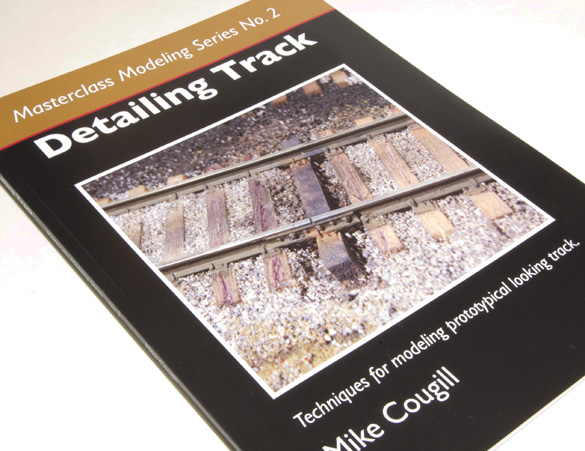
Mike Cougill’s recent post on the positive impact of removing track from his layout has led to some interesting debate, as well as a stunning photo. It has, as usual, got me thinking, and thinking about the opportunities different scales offer for different types of authenticity. I may be repeating some of several previous posts, but the threads are drawing together, and who knows, I may spend less time thinking and more time modelling soon?

The late Don Boreham, who was an inveterate and excellent narrow gauge modeller as well as long time secretary to the Model Railway Club in London, wrote in his book on Narrow Gauge Modelling that “perhaps the best scale to use is the largest one has space for”.

I like that phrase as it is rather subtle. Does it mean we should all work in 1:32, for example?

Not at all, but it does suggest that 1:32 is great for modellers who are interested in modelling items of rolling stock, rather than operations. Similarly, if one is driven to recreate the impression of trains in the landscape, then a smaller scale is indicated. In the first case, a coach or locomotive is the defining feature of modelling. In the latter case, the defining feature is train, or perhaps even train-in-landscape.

I personally find smaller scale layouts more impressive if they are placed in a relatively large space. It’s not that I am not impressed nor interested in the quality of fine detail and engineering in N gauge, for example, it’s simply that what impresses me is a train moving smoothly and deliberately through the scene: without quality engineering applied to mechanisms, there is no realism.

With larger scales, the individual models become the focus and there may not even be a scenic setting – being pulled by a model steam engine on an outdoor elevated track, the realism is about the authenticity of the motive power, the smell, the sounds, and the engineering. But again, a well engineered model will run well and be more authentic. Sorry to some of the “live steam” guys, but slip-eccentric valve gear requiring a manual push to set it doesn’t really do a lot for me.

I personally think that 1:32 is about as small as the “model engineering” approach can go, and also about as large as the “modeller” can go. In between, we have a continuum from Z scale up to 1 scale, maybe even larger for narrow gauge (15mm scale on 45mm gauge track, for example). Anyone with a large basement and an inclination to replicating operations will obviously find 00/H0 or possibly N ideally suited to their needs, as they require a large number and variety of robust models. The realism here is about authentically replicating a number of “railroad jobs”.

I think S possibly chose me, rather than the other way round, but it is the largest scale I can fit into my available space, and I like making things, so it suits me very well. (I have tried other scales, but always return to S.) Mike has a bit more space than I, and obviously derives great enjoyment from modelling the fine details, so 1:48 suits him well. If I had more space, maybe I would model in a larger scale, too: what I want is to build models to a high level of detail, and then to move them about in a purposeful manner, replicating real railway movements and operations. I need sufficient space for a layout of a station or a yard, tempered with the largest size models I can get into that space.

The interesting thing, of course, is that to be effective, all of these approaches require reliable engineering as anything else destroys the realism, but as the scale gets bigger (in terms of the model size, rather than the number used!) the focus begins to shift from quantity of operation to quality of operation. This does not make either of these “better” than the other, merely reflects the preferences of the individual. Rather than work against a sped-up clock to get a train rapidly sorted and on its way, I want to concentrate on the individual stages involved in coupling up: approach slowly, stop short, inch up, connect pipes (if required), pull back and place with other vehicles. I wouldn’t have time to model these niceties if working a large sorting yard against the clock: maximum use would be made of automatic coupling facilities: engines would still approach carefully, but they would not stop in advance of coupling up, nor would they pause for pipe connections to be made and (if necessary) automatic brakes tested. I am more interested in the operation of a train, than operating trains. Others differ – and wouldn’t life be boring if they didn’t?

Where anyone sits, is entirely up to them, as is where they judge the competing aims and advantages of different scale to meet and overlap, but I put it to you that unless you have the right balance and blend, you will be unhappy in your modelling.

If you are, then very good.

Makes you think…

As some of you will know, I have become a regular contributor to discussions on Trevor Marshall’s Port Rowan blog and Mike Cougill’s OST Publications blog. Both of these can be found via my links section (to the right for most computers, but to the bottom on tablets).

It was stumbling across the thought processes which led to Trevor’s Port Rowan layout, via the S Scale SIG forum (I am active there, too, but you need to register as a member to read it) that got me out of my modelling doldrums and frankly gave me the slap across the face that I needed to make me realise that it is possible to combine something like the ramshackle emptiness of the Bishop’s Castle Railway with North American prototypes. This re-awakened my long-standing interest in the short lines owned by the Central of Georgia, which has been further strengthened by reading around the subject, and making contact with Steve Flanigan, who models the Louisville and Wadley in H0 in a small space and has shared the fruits of his personal research with me. But then, he is North American, and what are North Americans for, if not generosity?

What Trevor has really done, though, is to take operations in a slightly different direction from what seems to be the norm in North America, based on magazines and websites.

Instead of trying to run as many trains as possible over a large basement empire with multiple stations, based on use of waybills and timetable and train orders (TTO) and a dispatcher, etc., he has concentrated on the individual operations around running the daily mixed train. This includes pausing to pump up the air, align couplers, connect hoses, etc. An out-and-back turn can take up a couple of hours, after which there seems to be a visit to a local hostelry for good food and decent beer. OK, this isn’t everyone’s cup of tea, but it is my pint of ale!

On top of this, we get superb modelling (on a par with Barry Norman and Maggie and Gordon Gravett) and a generous sharing of ideas and techniques. Well, he is Canadian, and what are Canadians for, if not politeness?

Mike’s forum is subtly different.

The same basic theme is there, that you don’t actually need a lot of layout to have a lot of fun. You get the fun by trying to model everything as faithfully as you can – the joy is in the detail.

Mike has published some booklets and books and also “The Missing Conversation”, which will form the subject of another post, but he also makes a though provoking post each week on various aspects of the hobby. He has also been editor of O Scale Trains, and a regular columnist on finescale matters in that magazine. What I like about Mike, or to be more accurate one of the many things I like about Mike, is that he has taken a stand on behalf of Proto: modelling. I have always hinted at this (and not very covertly), but knowing that I am not a lone voice means I take that stand too – albeit feeling slightly ashamed for not having taken it more clearly sooner. Well, I am English, and what are Englishman for, if not self-deprecation?

More importantly, Mike has generously provided, via his blog, a forum for intelligent, thoughtful conversation. My experience of Americans has always been positive and I wish some of their modern politicians were more careful about the impression they create on the world stage (but then, they are politicians, and what are politicians for if not promoting their own importance?)

I realise that for many people, a hobby is about getting away from thinking, but I am not mindless and I enjoy having my thoughts provoked. In the case of these three gentlemen, it has been to open my mind to what was lurking away at the back of it, and get me more interested in modelling than I have been for some time.

Thanks, guys!

If you have been planning to, well, go on then.

Elitism: in the mind of the accuser

Whilst driving to visit a model railway exhibition, I was listening to the radio. I always enjoy listening to “Desert Island Discs”: the format is superb, the host (Kirsty Young) perfect for the role, and the guests are varied and interesting (although sometimes, not quite how they think they might be interesting!) The guest on Sunday 26 May, 2013, was the dancer Deborah Bull. Now, I will be honest: ballet and dance, like opera, are not my bag – but I suspect my life is the poorer for not really understanding them. However, it is always interesting to listen to someone who is among the best in their chosen profession.

It was an interesting and pleasant interview, but about two thirds of the way into the programme (round about 32 minutes if you wish to jump to the relevant part of the podcast), Ms. Bull said something which really caught my attention, in response to a gently provocative question about funding for what is seen by many as an “elitist” art-form:

“Arts are practiced by elite artists, but are not intended for an elite group of people… …Everyone has the right to expand beyond their immediate horizons.”

Wow!

I don’t like the use of the word “right” in this context, preferring “opportunity”, but I have to say I agree wholeheartedly with her on this. It also applies to model railways. Just because my magazine of preference is the “Model Railway Journal”, just because I know some pretty outstanding modellers, just because I prefer to give honest feedback if someone asks for advice, in short just because I want to take the opportunity to be better and exchange ideas with others who wish to do this, doesn’t make me elitist.

I mean, why would anyone want to be a champion for mediocrity?

If you don’t, please do.