Realism

Does it look real? Well, decide for yourself!

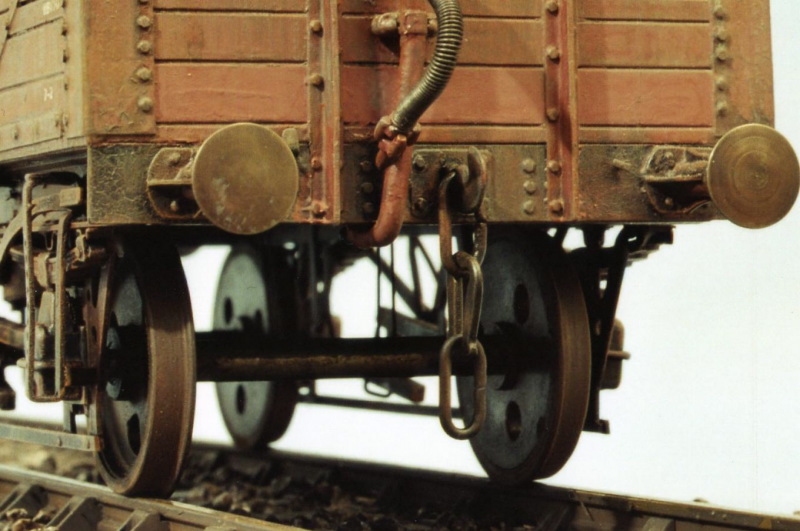
Ex LNWR DX goods, mostly the work of Trevor Nunn, on Barry Norman's Lydham heath

Ex LNWR DX goods, mostly the work of Trevor Nunn, on Barry Norman’s Lydham heath

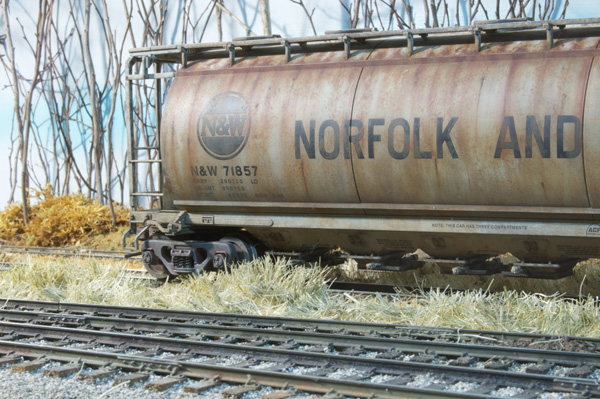
Mike Cougill’s astonishing work in Proto:48

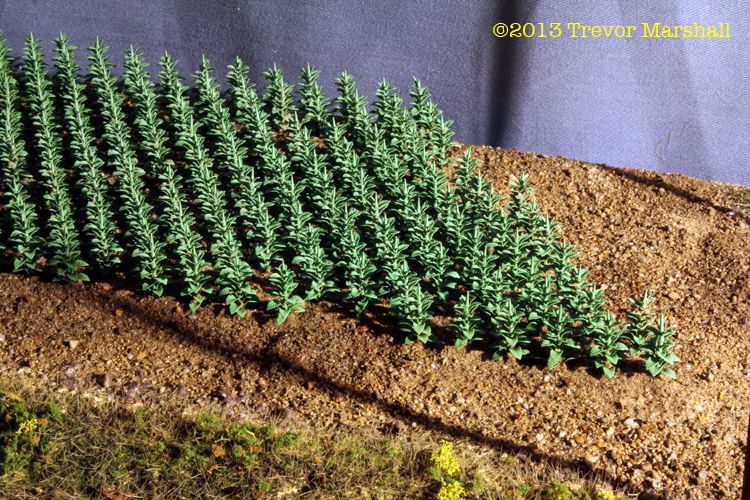
Trevor Marshall’s Port Rowan.
I know I have mentioned it before, but this is simply excellent.

What you don’t notice, at first, is the fineness of the wheels, etc. Just like the real thing, they are the right size to do their job, and they blend into the background as they have the same degree of delicacy as everything else.

Widen your horizons…

There are those who do not look far beyond their own shores and they are called, well, idiots I suppose.
There are those who do not even look as far as their own shores. They are called complete idiots.
I know people who won’t look at a layout unless it follows their prototype theme, and is in their scale/gauge. Suggest that they look at a model of an overseas railway, and they will tell you that they are not interested in (and I quote) “that foreign muck”.

As I said, complete idiots.

I won’t condemn them (they can do that well enough themselves) and I won’t pity them, either (suggests I might like them). Sometimes I feel like Gregory House, except that I do actually like the 1% who seem to think, and fervently wish the other 99% would do the same.

Here in the UK, some like to proudly think of ourselves as the inventors of “finescale” railway modelling – I mean, look at P4, etc. Well, apart from the pioneering work conducted by Ian Pusey in developing the S Scale standards – work which fed into the MRSG and the development of P4 – I suspect that is complete rubbish. Good ideas are good ideas, and they happen all over the place and often independently at around the same time. (A possibly Marxist view of history, but I don’t think so. In this case, people simply began to have enough leisure time to investigate railway modelling as opposed to toy trains. Oh, that is a Marxist view.) We also tend to take the view that Americans know all there is to know about scenic modelling: ground to ceiling mountains, etc. Again, this is complete rubbish: for a start, Trevor Marshall is a Canadian! Even if we ignore the work of such people as Barry Norman and Gordon Gravett, what about the work of New Zealanders like Peter Ross? What about the masterpieces produced in Europe? It’s not all out of the box Fleischmann train-sets over there, you know.

In this vein, I would like to draw your attention to a link I have already put up in a side bar (or at the bottom, if you are viewing on a tablet. Or at least, on my tablet) by mentioning it here: if you are the kind of person that likes Trevor Marshall’s work, then you will love Mike Cougill’s astounding modelling in Proto:48. Ignore the fact that it is 1:48 scale. Ignore the fact that the ties (sleepers and timbers) are closer together than UK practice. Ignore the fact that it follows American practice. Ignore the fact that it is set in the back of beyond (also known as Ohio). Just concentrate on the fact that without any rolling stock in place, it looks real, thus:

Then read his website on how to achieve this, and buy his book on detailing track. His service is great, and the book is really useful. And no, I don’t get commission. Sadly.

Good modelling is good modelling, no matter what scale, what prototype.
You might also want to look at Pierre Oliver’s website, too, for more of this:

If you want to, then why not?

Inspiration – and agreement

One of the things which has restored my mojo, and help me through the jungle of diversions to the oasis of focused calm is Trevor Marshall’s rather wonderful blog, about his project to model the CNR’s branch to Port Rowan. It is well worth a visit, but be warned, like many prodigious bloggers, his modelling output is fairly rapid, too. There’s a lot to read…

By pure chance (we never notice coincidences when they don’t happen) his latest post mentions that he weathers his scenery, to produce subtle variation in tone, and take off the plastic look. As you can see, this approach to colour as part of the finescale approach is well worth the effort.

Finescale: an attitude of mind

The word “finescale” is often banded about in model railways, without any clear meaning and sometimes as a term of abuse. As far as I am concerned it has a fairly simple definition:

“Making models look more like the real thing.”

That’s it. Proportion, shape, colour and texture are what it is about. Finer track standards and fine detail are a consequence of this approach, not the driver of it.*

Proportion and shape are closely related, of course, but essentially if a model doesn’t “capture the essence” of it’s subject matter, then no amount of work on fine details, etc, will redeem it.

Colour needs to reflect the muted effects of the atmosphere: muted, slightly duller (satin instead of gloss, everything else matt or dull) and considered use made of a restricted paint palette. Use of a “unifying tint” helps – I used to favour adding a drop of “BR coach grey” to all my tins of Humbrol paint.

Texture is less easily defined. Again, understatement is the key. It needs to be fine, not overdone. Sometimes this means using paint rather than anything else – dry brushing, for example, can suggest the texture of rust or Tarmac, as can careful use of weathering powders. In theory, a well maintained brick wall can be represented with brick paper: there is no way that the texture of the face or the mortar would show, if scaled down; yet the eye expects to see texture, so some form of embossing is essential, even if it is over scale! Oh well, there’s an exception that tests every rule…

Texture implies being careful about details, and it does mean finer track standards as they look more like the real thing, and more importantly when something moves, it moves more like the real thing, but the finer tolerances are a natural consequence of the approach.

I am also aware that for many people, this not of interest to them. I am OK with that: it’s a hobby and you get out of it what you will. And you are welcome to browse around the site and use any hints, tips, and ideas you pick up or develop by thinking how you would do it.

The other question is, is it worth it?

Well, that does depend on what you want from your hobby but if the picture below, courtesy of Barry Norman and taken during my dalliance with 1:32 finescale, is to your liking, then the answer is probably yes!

Most of what you see there is made from styrene sheet, yet the real thing was wood and metal.

*Of late I have come to the conclusion that the only way to make “00” “finescale” is to go to the EM “fine” standard, as used by Pendon Museum, Ultrascale, etc. Otherwise the proportions at the font end, and the placement of various track work features in turnouts, are simply out of kilter. Controversial? Not really: it’s simply a matter of being consistent. Working in S, this is not something I need to worry about, as we have a single set of standards derived from the prototype.

“It’s just the right size”

This is a common comment at exhibitions, almost as common as asking if it is EM or P4!

I have a theory why S is perceived as “the right size”, and it also applies to Gauge 1 in its (proper) 1:32 format. The human eye with the help of the brain measures things via angular displacement, binocular stereoscopy and perspective and as with standard geometry is pretty good at halving angles. If you take a half, and halve it, and halve it, and halve it, you have 1/32nd of your starting point: do it once more, and it is 1/64th of the original. It therefore “fits” just right into the mind’s eye. It’s only a hunch, but there is probably a PhD thesis that could come out of it! Incidentally, this also makes the scale ideally suited to the modern computational era: two to the power 6 is 64, or 100000 in binary….

So, the fact that it suits the eye is probably why people ask if it is EM or P4 – in the mind’s eye, this is the size their 4mm scale should be!