
Chris Mears has made an interesting post – not that he does any other sort – picking up on discussions about what it would take for P87 to become established in North America.
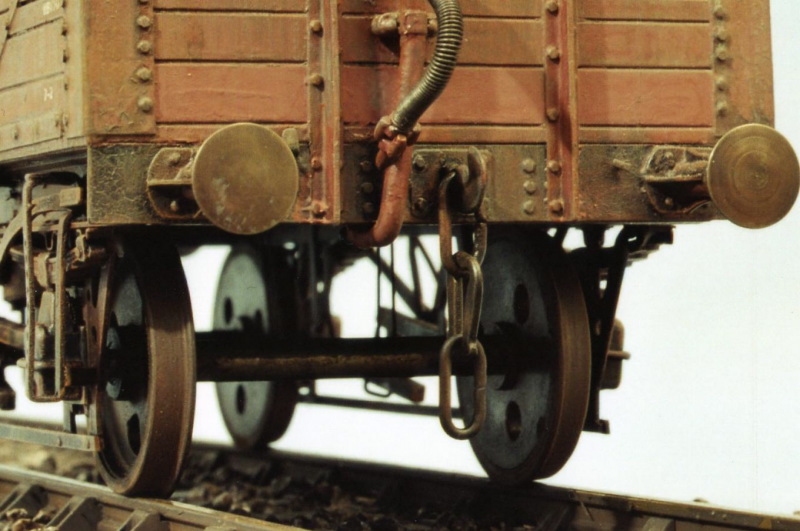
My understanding is that “code 64” wheels and P87 wheel and track components are available for freight and passenger cars and diesel engines, but steam is a different matter. Also, it isn’t just about the wheels and the track: with scale wheels, the truck frames can – and arguably should – be brought slightly closer together. In a reply to Chris’s post, I touched on the fact that what it needs is for someone to actually get on and do it. The biggest obstacle seems to be fear of becoming a “lone wolf”, unable to run stock on friends’ layouts and vice versa. That is a poor excuse, as most of us have more equipment than we need, so why not have a few extra items to the other standard? This enables the P87 modeller to run finely detailed engines elsewhere, and encourages the H0 modeller to have a go at P87. For passenger and freight cars, it may be as simple as having a few spare trucks and swapping them over now and then.
I can think of several possible subjects which be ideal candidates for a reasonable P87 layout that would not be too demanding, yet interesting enough once built to enjoy operating them. Some are real, some are models, and some are inspired by the approach taken to modelling a real location. All bar one have relatively few turnouts and require little in the way of equipment: if modelled in the diesel era (which might be stretching things a little for a couple of the suggestions) then re-wheeling would be neither expensive nor time-consuming.
The obvious candidate would be Port Rowan, or Port Dover: already done in S as we know, but in the same space a model of Port Rowan station could be modelled more or less to scale length, with a longer tail track than Trevor Marshall could accommodate.
Another prototype-based model line which lends itself to adaptation for a P87 first layout – not least because it can be built in a modular fashion of discrete scenes, as confidence builds up, is James McNab‘s Grimes Line. (Yes, two links: one for the blog, the other for the site)
A couple of Eastern Seaboard prototypes come to mind, partly because I have already mentioned them on my own blog, are the North Stratford RR and the Edgemoor and Manetta.
For a trio of Proto-freelance layout ideas, two small and one moderate – and the small layouts could be connected to the moderate – then I think there is serious potential in some (or all, if you are brave enough!) of Mike Confalone’s Allagash Railroad. The rickety track and backwoods nature of what is now the Andover branch is a great starting point (the video demonstrates the rapid starts and stops of an Alco RS3, together with DCC sound). The original “Woodsville Terminal” layout, being a long, thin shelf, is relatively straightforward to fit into a house, or as a portable layout built in sections: UK practice would fit this onto four sections 48″ long, pair for storage face-to-face. The Regis Paper mill at New Portland is anther candidate for a small but satisfying start in a limited space. But New Sharon Junction, with the branch and the yard, wold make a great centre-piece for a moderate layout in P87, especially if there were a few yards of carefully crafted scenic running either side of the main station, and if there is room for the branches for pulp wood (off the “Atlantic” branch on the plan) and the paper mill (as is, coming off Carrabassett Junction) – indeed, one could supply the other. Staging at each end for a small number of trains would provide for a very satisfying scheme, capable of leisurely solo-operating (one train at a time) or a handful of friends coming round for a full-session with trains on the main, the branches, and a switch job in the yard. He has published some e-books, available from the MRH site, which I can thoroughly recommend (usual disclaimer).
Finally, what about Ryan Mendells’ Algonquin Railway? A perfect example of a layout design which could be used for a P87 layout.
The only thing a P87 requires more of than a “standard” H0 layout is time: a few hours extra to build the turnouts and plain track (if ready to lay flexi is not acceptable – it can always be replaced, piecemeal, at a later date) and a bit more time putting in new wheelsets. But even the latter is good practice, standardising on a single tyre profile is the first step to better running and using P87 sorts that out – otherwise, it is better to standardise on a single manufacturer and make sure the track matches it (so doing it properly probably requires hand-built – or at least hand-tuned – turnouts anyway). All the extra detailing is likely to be of interest to anyone prepared to consider P87 in the first place.
The rewards are immense: a railway that looks and runs like a real one.
So, what is really holding back P87? I suggest inertia, not of the physical kind, but of the psychological variety.

 The Erratic and Wandering Journey
You must be logged in to post a comment.