
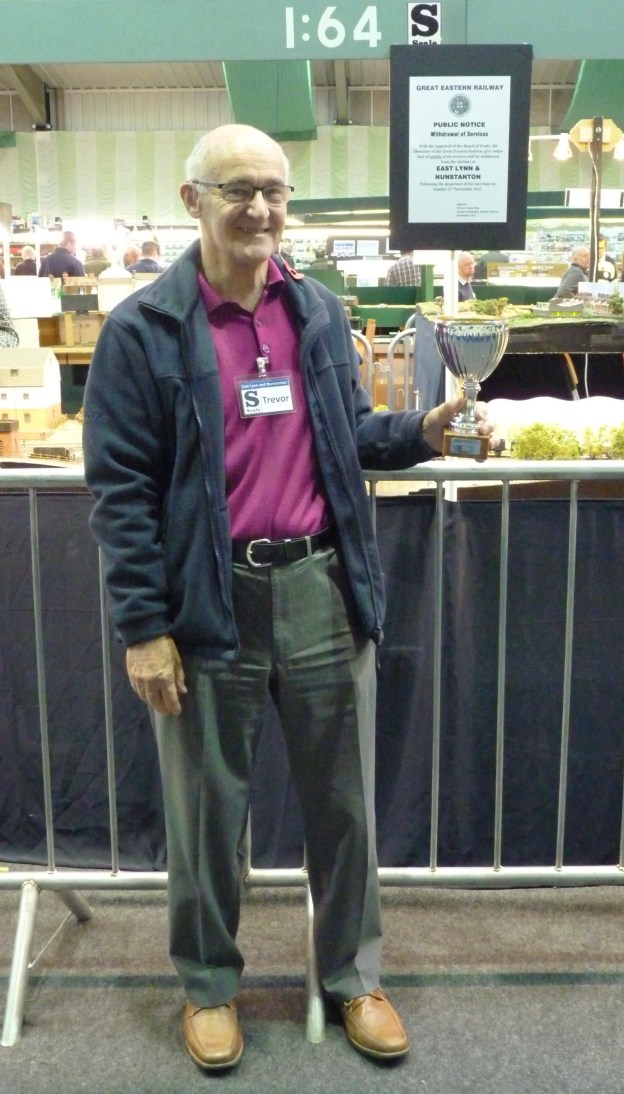
It is with a heavy heart that I am writing to inform you of the passing of one of the hobby’s true masters, and a very close friend, Trevor Nunn.
As a quiet and unassuming person, Trevor never sought the limelight and was perhaps not as well known generally within the hobby as he might have been: had he worked in 4mm scale, he would have been seen as a guiding light. But as soon as he saw S scale in 1973 he knew it was right for him (see MRJ number 10). Trevor was quietly determined, and once he wanted to do something, simply got on with it, learning new skills and techniques along the way. At this time he had a young family and they also moved house a few times due to work and also what he once described as one of his other hobbies: taking on houses in need of a bit of attention, and doing them up, so work on the new layout progressed in fits and starts, but he quickly put together a small portable layout, “Wicken”, along with a couple of locos (a GER 209 -LNER Y5 – class 0-4-0ST and a G15 – Y6 – 0-4-0T tram) plus some wagons and a couple of coaches and started exhibiting. By 1980 he has built his wonderful E22 (J65) “baby buckjumper” and with the addition of Len White’s S56 (J69) buckjumper, was a regular on the exhibition circuit: Wicken was 14’ long and only 16” wide, and packed away into two units 3’6” long and about 16” square (two pairs of boards, face to face) so it was easy to transport and store. After a few years where modelling took a back seat to other activities (see above!) and during which progress was slow – the E10 0-4-4T took nine years to build – Trevor took early semi-retirement and started work on East Lynn in 1993, which debuted in very basic form at Leicester in 1995, followed by The Scale Show in 1996 and then the CMRA show in 1997, which led to a lot of exhibition invites – I know, because I was his primary assistant for the first 120 days or so!
Although not averse to using some components made elsewhere, such as the late Trevor Charlton’s etched zinc coach sides, some wagon body castings and of course, a few etchings for axleguards (“W-irons”) and detail castings, plus coach and wagon wheels, Trevor largely built from scratch – including making the wheels for his locos! Even some of the castings he used were from his own patterns, such that the only genuinely bought-in parts of his superb GER G14 4-4-0 (with working Joy inside motion) were the motor (Mashima) and gearbox (High Level) and etched number plates. He even painted and lined his locos himself, as well as his rolling stock – all hand lettered. He shared his techniques within the SSMRS Newsletter/Gazette. Having tried a few of them myself, I learned how clever were his ideas – and how much a taskmaster he was to himself: real care was required over the precision of workmanship. Regular practice and discipline were the keys to effective results here, and watching him work or receiving instruction/guidance from him revealed that he took less time than I did because he was as well rehearsed as he was well-versed in being a methodical engineer. (By trade, he designed and built the mechanical parts of medical instruments.)
Trevor enjoyed exhibiting – he rarely set up his layouts at home – and liked going out on the road. These were also good social occasions for those involved with supporting him – many SSMRS members would turn up at a show and be given a controller and a shunting pole – and although he didn’t build models with the intention of getting awards, the quality of his modelling meant that inevitably he garnered many cups for “Best Layout”, both from the visiting public vote but also more rewardingly from other exhibitors. The ultimate accolade, perhaps, came from the late Bob Essery, who when asked what his highlight had been in the hobby, commented on watching East Lynn being operated. The point was, the layout worked superbly, was operated properly, had working signals, and to cap it all, was largely hand-built from scratch! At one of the Chiltern Model Railway Association events, the late Iain Rice cast a critical (and appreciative) eye over Trevor’s masterpiece, the GER G14 class 4-4-0 with working inside Joy’s valve gear, and turned to Tim Watson and remarked, “This modelling is where I get down on my knees in respect.”
In building East Lynn, Trevor started to scribe and paint his own brickwork, at first directly onto the plywood carcass (the station building) but then onto cartridge paper, and to represent carstone with scribed and painted modelling clay. He thoroughly enjoyed doing this, and despite saying he had no plans to extend the layout, he soon added to it with the Quayside for East Lynn, on which there are a number of buildings, each of which took him as long to build as a loco (between 150 and 300 hours!) He also turned a slightly rough and ready kit for a Thames barge into a superb model, which drew admiration from his friend Gordon Gravett (who used to build models of ships for a living). This took a solid 2 months of his time, up to 16 hours a day – quiet determination meant that once he had the bit between his teeth, he really got down to it. (And at other times, he might not do any modelling for several weeks, if he felt disinclined: “No point doing it if you won’t enjoy it.”) Having completed this, Nunstanton was added, along with increasing rolling stock including for the M&GNJR, so by 2010, there was 28’ of scenicked layout available for exhibition, which debuted at the CMRA in 2010. Finally, the existence of some reasonable quality ply plus the M&GNJR locos and stock gave Trevor the excuse to build Trowland, a small layout only 8’ long – again, easy to transport and with a lot on interesting operating potential.
In amongst this, Trevor built a number of locos, or parts of locos, for others and would also help with making something that didn’t run quite as well as hoped, run like a Swiss watch. I have three such examples, and know how well they run.
A few years ago, he bought a house with a small barn/large garage at the rear, and the whole edifice of East Lynn and Nunstanton was erected and available for operation, as happened a few times at what were also social gatherings. As he became more aware of time passing, he made his layouts available to anyone interested, preferring to know where his models were going rather than them being spread amongst collectors who might not run them. As a consequence of this, I own both East Lynn (without the quayside) and Nunstanton as well as a substantial portion of the GER locos and stock, although I cannot set the latter up at home, and the former only on occasion. (This will change soon on moving house.) East Lynn is scheduled to appear at the Cambridge 31A exhibition in September 2024.
I first encountered Trevor in the late 1970s, at a number of local model railway exhibitions where he was present with “Wicken”. I even spent a weekend helping a friend with his 00 layout at the Milton Keynes exhibition, placed next door to Wicken. The gauge of the track and the size of the models drew me in, as they had for Trevor a few years earlier. As a shy teenager, I didn’t ask any questions but listened in as Trevor generously explained how he made things to anyone who asked. At a later show I grabbed an information leaflet and wrote to the S Gauge (as it then was) Model Railway Society and received a response suggesting I introduce myself at Milton Keynes in October 1981, where Thame was present, and lo and behold, there was Trevor, and our friendship started there and then – soon I was operating Wicken at any exhibition I could get to (not many as I was a student and usually too far away!) which culminated in becoming a regular operator by the late 1980s, and thereafter to assisting with the superlative East Lynn as it expanded to incorporate the Quay, then Nunnstanton, and of course the stand-alone Trowland. Despite the “generation gap” we always got on well, and Trevor never spoke down to me. In fact, he never did to anyone. He was as open as he was unassuming, and always happy to talk to anyone who was interested, and very generous when it came to sharing his experiences and techniques. I personally learned a lot from him, but not solely as a modeller. In those sometimes long journeys together to and from Exhibitions, it is impossible not to develop bonds of friendship. He gave me the only useful advice about parenting, when my first child was on the way: “Don’t believe all the rubbish. You’ll get what you’re given, and have to do the best job you can to bring them up well.” That stood me in good stead and helped me stay sane as my children grew up!
The hobby has lost one of its greatest all-rounders, and I have lost a very dear friend and trusted advisor. My condolences go out to his widow and children, who like Trevor I am pleased to call my friends.


 The Erratic and Wandering Journey
You must be logged in to post a comment.