Author Archives: Simon

Unknown's avatar

About Simon

Erratic, wandering, journalling rarely…

Armchairs

I have been amused by recent events on a web forum, relating to a letter published in a model railway magazine. The letter was pleasantly worded (I checked this with my wife, who is not so much a disinterested party as a supremely disinterested party) and made some observations relating to such things as the correct uniform and headgear for a policeman in that part of the country at that time, what sort of bus would be present and the paint scheme it would carry, and so forth. All in all, I would say this is really useful information, and it was offered freely so that the layout concerned could be even better – and so that anyone else interested in that particular time and place could take one step closer to creating a realistic scene. I am sure we have all watched films and TV shows and commented (or thought) that the train being used didn’t exist in the era or location in which the unfolding story is set. Well, this is that sort of issue: “Here is something I know, because at that time, I lived in the area. If you get this right, then your layout will be even more believable.”

The builder of the layout being “criticised” was upset about this and viewed it as very negative nit-picking, and was more than a bit churlish and childish about it. Unfortunately, the inevitable storm in a teacup ensued, and rather than point out that the letter actually required some effort to write and was intended to provide information of help to the layout builder so could he please calm down and put his toys back in the pram, his on-line “friends” sent him messages of support, and generally joined in the condemnation of the letter writer and the magazine editor for daring to print the letter and thereby increase the sum of human knowledge. Anyone attempting to put the other view was subject to the usual cyber-activities of ad hominem attacks rather than reasoned argument (difficult to put one, if there are no reasonable arguments). It was a disgusting sight, thankfully brought to my attention sometime after the event and the matter was deemed closed, so I managed to avoid making a silly arse of myself by getting involved. As my wife said, “It’s only toy trains at the end of the day.” As she is a community-based psychiatrist and is told to go forth, multiply and die a horrible death on a daily basis, she thought the abuse was quite lightweight, but she has seen internet bullying in action elsewhere and thought the above event was unpleasant. I only hope that the upset party has written a letter to the magazine, expressing his displeasure, so that the editor can print it and let the world see how petulant and petty some people can be in the face of criticism. I doubt that a response would be really necessary.

What, you may ask, has this to do with armchairs? Well, one of the more childish responses made against the letter writer was, “Until she [yes, it was a lady modeller] shows us that she has built a layout, and offered it for criticism, she can’t comment on anyone else’s layout”. This sort of line gets trotted out at regular intervals, often with the phrase “armchair modeller”, but just because it is regularly repeated doesn’t stop it being poppycock. On this basis, I cannot vote as I have never been a politician; I can’t proclaim my preference for Mozart over Beethoven as I have never written a concerto or symphony, and so on. (I presume that, although very amateurish, the fact that I have written directed and produced school plays, and help with scenery construction, lighting and even acted in amateur dramatics, I am allowed to have an opinion on the theatre, if not plays in general. Or am I restricted to amateur productions and pantomime?)

No, this is ludicrous. By all means react appropriately to people who tell you how you must conduct your modelling, especially if they have never done anything at all themselves, as this is rude and presumptuous of them. But offering an opinion? Suggesting a possible but different approach? Proffering more information? Since when have we ceased to have a free society, and one which requires experience of delivering entertainment/products/services rather than simply enjoying them before being able to think and talk about it?

Thankfully, the finescale modelling world seems more tolerant of people making an effort and the sharing of information, but can still fall back on the, “Where’s yours, then?” school of response. But may I suggest that next time someone politely offers a suggestion, provides information or even proffers criticism, ask yourself if they are trying to help you – and thank them if you think they are.

Easier panelled coach sides

I would love to take credit for noticing this, but in all honesty must thank Chris Mears for bringing this to my attention.

Chris Mears's avatarPrince Street

I’ve only just discovered the Yeoton Wharf blog. The blog itself reports on the construction of a beautiful 3mm scale railway set in Victorian times and featuring a mix of broad and standard (oops, sorry, narrow) gauge track. While browsing through the blog’s pages I came across one in which he descibes his method for producing panelled coaches:
http://nsalzman5853.wordpress.com/2012/04/17/panelled-coaches/

The process couldn’t be simpler and certainly couldn’t be more brilliant!

Step:
1 Print coach side elevation onto a sheet of self-adhesive label paper
2 Stick label “side” to a sheet of thin plastic
3 Cut out the window openings (the glazed bits) removing the plastic
4 Cut around the panel lines removing only the label material where the raised panel beads should be

…and there you go. Three easy steps and it should be quick, reliable and yield a very nice looking car side. As testiment to the process he’s…

View original post 98 more words

Physics Room 101

Well, it has been a while since I posted, but I have had little to say – I hope I have done it eloquently.

Anyway, I have been assembling L-girders, cutting sub road-bed, and generally making noise playing with power tools. More will come along soon enough, once glue has dried and my ideas have been proven.

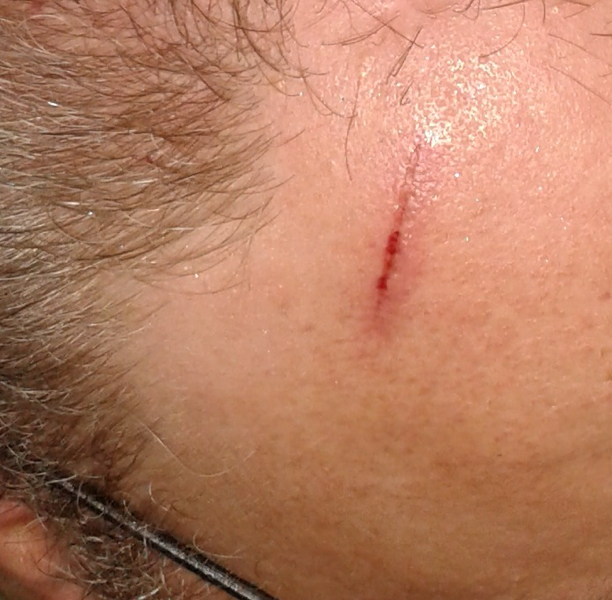
Today, however, was an opportunity for a (not so) gentle reminder of basic physics, involving an over-hanging L-girder rigidly if indirectly fixed to the wall as the immovable object, my body as the irresistable force*, and my forehead as the active participant in the lesson.

head

I’ll say this: as we’ll as being simple, quick and effective, L-girders are very robust…

* Someone, somewhere, must find it so…

Solifluction

Like me, the chances are you will have to look that up, but it is a geographical term relating to the effects of thawing and freezing of, for example, soil above permafrost. Each year, the thaw on the surface leads to over saturated soil above the permafrost, and it slips. Then it freezes again, and the cycle repeats. The consequence of all this is to create small steps in hillsides, etc, as show in the (linked) photo below from this very helpful page.

Solifluction in the Cairgorms

What has this to do with model railways? Well, recently there has been some discussion in various places, but particularly on Mike Cougill’s blog, about how great our hobby is from the perspective of personal satisfaction. We don’t just model a locomotive, as would someone building a radio-controlled vehicle, aircraft or boat. We model the whole scene, and also add movement and logical operation. (Nothing moves on a real railway without there being a purpose. This is also true of some layouts, where the builder has taken the trouble to find out about the real railway.) What the hobby teaches us, more than anything else – more than joinery, basic electrics and often some electronics, sculpting (of landforms), architecture, geography, history, economics, civil engineering, mechanical engineering, electrical engineering, metal working, use of tools,  and so on – is observation.

Observation of the real thing.

All good models start with an observation of the real thing. Generally speaking, unless you are building a model of something akin to the creations of Roland Emmet, railway modelling is not an abstract art – it is nowhere as difficult as that. As an art, it starts with observation. I learned about bonds used in brickwork from Iain Robinson (who has today introduced me to the word solifluction!), via the Railway Modeller, I have learned a lot about texture and colour from Barry Norman and Gordon Gravett. I have developed a love of history beyond railways thanks to the hobby – school put me off that! I could go on. (I often do, according to some many…)

Sometimes it works the other way round, too. I was motivated to learn about shading and perspective at school in art lessons by being allowed to do a perspective drawing of a railway station, with shading to show the direction of the sun. I also learned about observation from my 5th form (year 11, eleventh grade) art teacher, when trying to paint a tree and failing because I had used brown and not a few shades of grey (fewer than 50, I hasten to add!) In fact, I put my astounding performance* in my art exams at the age of 16 down to the drive to observe, rather than anything else, and that came from the hobby.

So, solifluction is another thing I have learned from the hobby, and I shall keep an eye out for it in future!

If you weren’t, you will now…

Simon

*In case anyone is wondering, the words “astounding performance” were used by my art teacher (not sarcastically), who had “inherited” our class from someone who had left part-way through the year, to describe my achievement against my natural ability. I failed.