Picture reproduced by kind permission of Trevor Marshall
Just a train running through some woodland, next to a river, right? Yes. And also, no.
Yes: it is a train; there is woodland; and there is a river.
No: it is not just that; it is not even a simple case of the whole being more than the sum of the parts. There is more to it than that. But not too much more, and best of all, these are basic principles, attitudes and activities which can be applied to any creative activity, but which lie at the core of “finescale with feeling”.
Observation – This could also be called “attention to detail”, in that it is about identifying the detail points in the prototype: the slope of the embankment (“fill”, if you are North American); the texture of the grass and leaves; the size and shape of the trees; the correct details on the train. If you get this stage wrong, then the result cannot be “closer to the prototype” and I would argue that it is not finescale. To get this right, spend time observing.
Composition – How best to arrange things. Not as simple as it might seem. The prototype often disappoints in this respect: notable painter Constable altered the arrangement of the real world to improve his famous picture, “The Haywain”. Trevor has written some interesting musings on his composition of the Lynn Valley, and of course has put them into practice, too. There is a large element of “love of subject” here, as the aim is to make subtle adjustments to the real scene so that the model displays it all in the best light. This is feeling. To get this right, spend time immersed in information: books, photos, videos, site visits, and then play around with plans, card mock-ups, etc.
Execution – The quality of workmanship. A high degree of skill is required (the hallmark of finescale) but also the care of that workmanship – back to feeling – makes this a believable representation of the real world, even if it isn’t an exact copy of a real place. This is true finescale with feeling. To develop and hone a skill, spend time getting a feel for tools and materials.
None of this comes automatically, except maybe to the very gifted few. Not all of us can reach the high standards displayed by Trevor, but as the major requirement for each of Observation, Composition and Execution is simply time, we can all try at our own pace, and each of these can be practised whenever and wherever desire and opportunity coincide.
At the end of the process, what do we see? Just a train running through some woodland, next to a river...
Well, it has been a while since I posted, but I have had little to say – I hope I have done it eloquently.
Anyway, I have been assembling L-girders, cutting sub road-bed, and generally making noise playing with power tools. More will come along soon enough, once glue has dried and my ideas have been proven.
Today, however, was an opportunity for a (not so) gentle reminder of basic physics, involving an over-hanging L-girder rigidly if indirectly fixed to the wall as the immovable object, my body as the irresistable force*, and my forehead as the active participant in the lesson.
I’ll say this: as we’ll as being simple, quick and effective, L-girders are very robust…
Like me, the chances are you will have to look that up, but it is a geographical term relating to the effects of thawing and freezing of, for example, soil above permafrost. Each year, the thaw on the surface leads to over saturated soil above the permafrost, and it slips. Then it freezes again, and the cycle repeats. The consequence of all this is to create small steps in hillsides, etc, as show in the (linked) photo below from this very helpful page.
What has this to do with model railways? Well, recently there has been some discussion in various places, but particularly on Mike Cougill’s blog, about how great our hobby is from the perspective of personal satisfaction. We don’t just model a locomotive, as would someone building a radio-controlled vehicle, aircraft or boat. We model the whole scene, and also add movement and logical operation. (Nothing moves on a real railway without there being a purpose. This is also true of some layouts, where the builder has taken the trouble to find out about the real railway.) What the hobby teaches us, more than anything else – more than joinery, basic electrics and often some electronics, sculpting (of landforms), architecture, geography, history, economics, civil engineering, mechanical engineering, electrical engineering, metal working, use of tools, and so on – is observation.
Observation of the real thing.
All good models start with an observation of the real thing. Generally speaking, unless you are building a model of something akin to the creations of Roland Emmet, railway modelling is not an abstract art – it is nowhere as difficult as that. As an art, it starts with observation. I learned about bonds used in brickwork from Iain Robinson (who has today introduced me to the word solifluction!), via the Railway Modeller, I have learned a lot about texture and colour from Barry Norman and Gordon Gravett. I have developed a love of history beyond railways thanks to the hobby – school put me off that! I could go on. (I often do, according to some many…)
Sometimes it works the other way round, too. I was motivated to learn about shading and perspective at school in art lessons by being allowed to do a perspective drawing of a railway station, with shading to show the direction of the sun. I also learned about observation from my 5th form (year 11, eleventh grade) art teacher, when trying to paint a tree and failing because I had used brown and not a few shades of grey (fewer than 50, I hasten to add!) In fact, I put my astounding performance* in my art exams at the age of 16 down to the drive to observe, rather than anything else, and that came from the hobby.
So, solifluction is another thing I have learned from the hobby, and I shall keep an eye out for it in future!
If you weren’t, you will now…
Simon
*In case anyone is wondering, the words “astounding performance” were used by my art teacher (not sarcastically), who had “inherited” our class from someone who had left part-way through the year, to describe my achievement against my natural ability. I failed.
How many trains can I (safely and reliably) drive at once? One.
You may think differently about your own abilities. Self-delusion is a great joy.
Until that train running around the loop unattended, whilst you run a second train, runs into the turntable well due to a mis-set turnout.
If it takes me five years to build the single loco to run that train, and effectively four re-builds during the process, why should I worry? I will be learning and improving all the while. I expect my layout to take between 10 and 20 years to build, after all. In the interim, there is the brass market and RTR diesels to keep me going, plus re-wheeled freight cars. All of these can be upgraded or replaced.
There is no rush to the finishing line, for there is no finishing line! The aim of a pastime is to pass time. If I can acquire new skills and a heightened sense of achievement along the way, well that’s as good as a hobby gets, isn’t it?
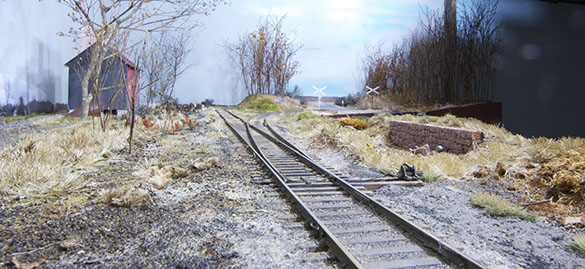
Unless you have stumbled upon my blog for the first time, Mike Cougill will be no stranger to you. As I have said before, the thoughtful postings on his blog have helped pull me out of my modelling doldrums more than once. And not because he gave me answers, either – not even because he gave me questions – but because he guided me to ask myself the right questions. Mike is very well read on matters such as “thought leadership”, which is not as nebulous a phrase as many might think – see my previous sentence about guiding someone to asking themselves the right questions – and has identified a niche in the model railway hobby for thinking. If you want to see how this operates, then have a browse at the excellent O Scale Trains Magazine website (out of print back-numbers are free), and read his column in issues 37, 38 and 39. If you like what he wrote there, you will enjoy the rest of his output, which produces such scenes as this:
Still life with gold bricker
Modelling Masterclass
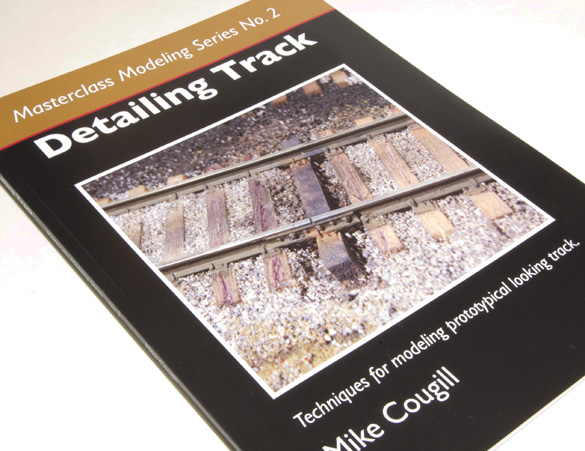
Under the series title “Masterclass Modelling”, Mike has published 2 books so far: the out of print “Pieces of the Puzzle” and the sublime “Detailing Track”. An e-book on Covered Hoppers, Volume 1 of a promising series on modern freight cars, has also appeared and provides detail photos that every modeller of these vehicles need. I don’t model these vehicles, but being fascinated by the prototypes, I bought it and learned quite a lot in the process!
“Pieces of the Puzzle” was Mike’s first venture into publishing, and as he admits, was a “learning experience”. It is now out of print, but Mike feels that issues 1 and 2 of The Missing Conversation make a fuller and clearer exposition of his thoughts on this title. I will review this no further, except to say that I really enjoy re-reading it.
If you want to learn how to achieve this, then the book is for you.
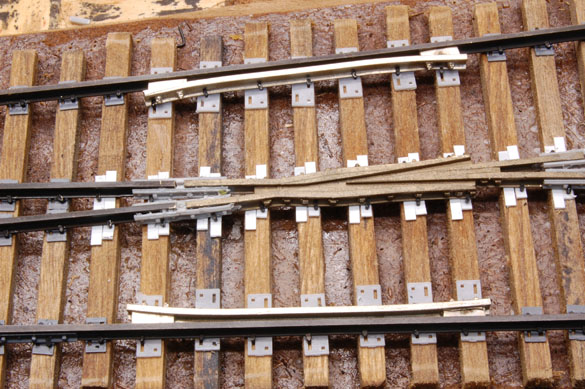
“Masterclass Modeling Series® #2 -Detailing Track” is a masterpiece worthy of a much wider audience in the hobby. Here is a book which deals with the prototype and how to model it, and is written for a discerning audience. How discerning? Well, if you wish to model track rather than simply lay track and ballast and paint it, then you are discerning enough to buy the book, and you will not be disappointed. It is profusely illustrated, informative, and helpful. Mike’s aim is to encourage modellers to “take the first step toward making that dream of a railroad in your mind a reality”, and this he does via the simple 3 stage process of outlining the design and use issues for the prototype, how these might be modelled, and then he actually does this, step by step. For a flavour of Mike’s approach, read this blog posting, and learn how to start producing work such as this:
“Hand laying turnouts isn’t hard. Getting over your reluctance and internal fear is the hardest part.”
I would have liked a bit more information on track from 100 years ago, when things were less standardised, and more generally on the placement of switch stands, but if you think track is a model in its own right and a key component of the whole modelling scene, then this book is for you, regardless of the country, period and prototype of your modelling, and I would advise that you order it now!
On page 46, Mike offers the best piece of advice I have ever seen, not just about modelling track, or indeed about modelling: stop before you go too far. (In this context, do not file too much off, do not over-detail.)
The Missing Conversation
Having identified a gap in the market for “folks looking for an in-depth discussion about the hobby” Mike has created The Missing Conversation with the simple aim of speaking to this “deeper, more thoughtful” audience. The Missing Conversation is built on three basic principles, which are fundamental to Mike’s approach to the hobby:
A scale model should be consistent from top to bottom, including the wheel profile and track gauge.
If the hobby is worth doing, it is worth doing well.
Details matter.
Apart from the publisher’s piece on the “back cover” (it is not a book, but a pdf) there are no distracting adverts. There is also no letters page – the OST blog serves this function, after all, and provides a forum for the conversation. The layout of the book is clean, simple, and elegant, including a reasonable amount of “white space”. The latter is important, as any student of Japanese art will tell you. It creates in this case “thought space”, i.e. it encourages thinking. There is no visual crowding to be carried over into the mind, so there is space to think. Reading The Missing Conversation is not to be hurried. Like good poetry, it repays careful thought about the phrases used, even the very words – and like good poetry, it can also be enjoyed as a leisurely read in its own right. It is not for everyone, I admit, but personally I think it is worth every penny. So far, The Missing Conversation has had the following issues:
Volume 1 – Layout Design: Asking why instead of how
Volume 2 – The Essentials
Volume 3 – Standards. Finescale standards in Proto:87 and Proto:48, with a feature on Warner Clark’s outstanding Proto:48 layout
Volume 4 – Craftsmanship. Featuring the work of Tony Sissons in 1:87 and Tom Mix in 1:48.
Volume 5 – Switching: More than meets the eye. Operations from the perspective of real railroaders.
In short, if you want someone to tell you what to think, Mike’s published output is definitely not for you. But then, if that was the case, I doubt if you would have read this far. Would you enjoy The Missing Conversation? I cannot say, but download the free articles, and if you enjoy them, you can ask yourself the correct question!
The Missing Conversation provides thought leadership for the hobby.
Pictures reproduced with kind permission of OST Publications.






You must be logged in to post a comment.