Category Archives: Thinking

Overcoming stereotypes

To quote The Beatles, and (with more relevance) Mike Cougill, “Tell me what you see”.

More years ago than I care to remember, I graduated in psychology. One of the things which really interested me was the processing of data. If we take vision, there is so much information streaming into our eyes and yet we can only process a fraction of it at any one time. To cope with this, we have evolved strategies to filter out the usual, and attend to the unusual, on the reasonable evolutionary basis that we need to identify things that might be food, friend or a threat and everything else is background. (When in a state of heightened anxiety, colour vision can cease to function as it requires a lot of energy to process the data, energy which might be needed for the purposes of a fight or a flight.)

A consequence of this is that the human mind is very good at forming stereotypes, particularly when it comes to uncommon things (like, for instance, someone not in the family group, or someone who models to finescale standards). If we see a coincidence of uncommon things, for example most railway modellers are normal people, and that includes finescalers, so a finescaler with a somewhat obsessive attitude becomes doubly unusual, then we form a stereotype based on the distinctiveness, but wrongly attribute the cause: so finescalers are seen as somewhat obsessive. The real problem comes when this becomes an archetype, and unfortunately this happened many years ago in our hobby. What the human mind then does is to look for confirmatory evidence to back this up, to preserve the distinctiveness, and myths arise and the “evidence” is routinely put forward to bolster the opinion of those who are threatened by things which do not conform to their way of thinking.

But it doesn’t end there: we do it all the time, and model what we think is there, rather than what actually is there. Hence, I think, the number of poor models of trees out there. Ask any young child to paint a tree, and you will be surprised to see omething which is not a variant on a theme of brown stick with a green blob, yet trees rarely have a brown bark, and the foliage is anything but a single colour blob. Clichés abound on layouts: “clutter” is added to improve the “atmosphere”, and we see lengths of rail (in anticipation or consequence of relaying work) left in yard areas where railwaymen on th night shift would trip over them. The result is inauthentic and, well, cluttered.

It is possible to train oneself to become aware of these processes, and to counter the negative stereotypes which can arise, but it isn’t easy: in fact it can be very difficult. This is one of the first things that art students have to learn: how to un-learn their preconceptions. When it comes to our hobby, I am afraid that lazy acceptance of the norm (well, it is a hobby and therefore supposed to be relaxing) is the norm, but for those who can be bothered to overcome this hurdle, the world is a much more interesting place!

I began with a quote, and will end with another fom the same song:
“Open up your eyes, now.”

Railway modelling is not fun

My friend Mike Cougill has made a few posts recently about model railroading and “fun”. He even went so far as to pose 20 questions on the subject. As he has recently revealed, these reflect his self-questionning, and he has answered some of the questions. I had a problem with the questions, as Mike had (intentionally, I am sure) left out any sort of definition as to what fun might mean. It got me thinking – I am sure that getting people thinking was Mike’s aim. It usually is.

Fun” is an interesting word. Originally the way to have fun was to play a trick, hoax, etc on someone – so fun came at another’s expense (for example, the bawdy and riotous story “Tom Jones” treats it this way). Definitions change over time (awful used to be a major compliment!) but the element of spontaneity is still a key part of most current definitions of the word “fun”, although playing tricks on others is not the usual meaning. It is also lasts for only a relatively short-term, so activities need to be repeated, or replaced with new ones. “Retail therapy” is a good example of this: and being of short term effect, it needs repeating. There is nothing wrong with fun, but it is rather ephemeral.

Enjoyment, is something more enduring albeit possibly at a lower intensity than fun. If we don’t enjoy something, we generally don’t want to do it. After a spot of retail therapy, we might enjoy the fruits of our purchases – maybe a spot of operating with our new purchases. Maybe a bit of weathering. You get the point: something which is enjoyable.

Satisfaction, though, is something altogether more permanent and rewarding. It is the reward that enables us to overcome obstacles. It does not deny fun, nor does it preclude enjoyment. Far from it: many things that go towards satisfaction may be fun and enjoyable, but when we find that we need to acquire and hone a new skill, it is the promise of eventual success that keeps us going. It also enables us to challenge our assumptions, and deny our frustrations, indeed these are essential requirements: without obstacles, assumptions, frustrations and lack of skill to overcome, where would be the satisfaction?

I mentioned enlightened impatience last year, the point being that one can turn impatience to advantage by using it to enforce discipline. If I know a job should take, say, 10 hours of careful work, and spend 8 hours on it, then I have sold myself short. Not only that, but I will end up redoing it – properly this time – and at the of the process will have spent 18 hours on a 10 hour job. That really annoys me, hence the discipline. The result, knowing that even though some parts of the modelling job may not have been enjoyable at the time and maybe none of it was “fun”, is very, very satisfying. And I know that when doing it: it keeps me going.

Fun is superficially attractive: it shows we have a sense of humour. Really? Do we really need to patronise our audience and ourselves by bringing things down to the lowest common denominator? I think the famous phrase “Model Railroading Is Fun” is glib, and ultimately misleading. The only people who gain from it are manufacturers, magazines with a vested interest in encouraging retail therapy to keep the advertising revenue coming in (no accident that MRJ, which is not dependent on this source of income is the most “finescale” magazine out there, and this is even more true of “The Missing Conversation“), and the lazy and superficial which can’t be bothered to try harder and are looking for an excuse to hide behind. I may get some flak for that last remark, but if you read it in context there is nothing pejorative about a considered choice.

Building a model railway, be it a small one with a few highly detailed scratch-built items of equipment or a large empire with the focus on operation (for which purchasing a lot of RTR equipment is necessary and not purely “retail therapy”) is a hobby with the opportunity to provide a life-time of satisfaction, with enormous benefits for one’s mental, intellectual and physical well-being. And on top of that, I have learned so much about the outside world. Not just the physical environment, not just the technical side, but things like social and economic history, different cultural impacts.

No, one thing the hobby isn’t is fun. It’s far more than that – although we can and do have our fun moments.

Calling it “fun” sells railway modelling short.

OCE – Three Steps Closer to Perfection

Have a look at this simple, beautiful picture:

wpid-x80w-lynnvalley-4sd.jpg
Picture reproduced by kind permission of Trevor Marshall
Just a train running through some woodland, next to a river, right? Yes. And also, no.

Yes: it is a train; there is woodland; and there is a river.

No: it is not just that; it is not even a simple case of the whole being more than the sum of the parts. There is more to it than that. But not too much more, and best of all, these are basic principles, attitudes and activities which can be applied to any creative activity, but which lie at the core of “finescale with feeling”.

  1. Observation – This could also be called “attention to detail”, in that it is about identifying the detail points in the prototype: the slope of the embankment (“fill”, if you are North American); the texture of the grass and leaves; the size and shape of the trees; the correct details on the train. If you get this stage wrong, then the result cannot be “closer to the prototype” and I would argue that it is not finescale. To get this right, spend time observing.
  2. Composition – How best to arrange things. Not as simple as it might seem. The prototype often disappoints in this respect: notable painter Constable altered the arrangement of the real world to improve his famous picture, “The Haywain”. Trevor has written some interesting musings on his composition of the Lynn Valley, and of course has put them into practice, too. There is a large element of “love of subject” here, as the aim is to make subtle adjustments to the real scene so that the model displays it all in the best light. This is feeling. To get this right, spend time immersed in information: books, photos, videos, site visits, and then play around with plans, card mock-ups, etc.
  3. Execution – The quality of workmanship. A high degree of skill is required (the hallmark of finescale) but also the care of that workmanship – back to feeling – makes this a believable representation of the real world, even if it isn’t an exact copy of a real place. This is true finescale with feeling. To develop and hone a skill, spend time getting a feel for tools and materials.

None of this comes automatically, except maybe to the very gifted few. Not all of us can reach the high standards displayed by Trevor, but as the major requirement for each of Observation, Composition and Execution is simply time, we can all try at our own pace, and each of these can be practised whenever and wherever desire and opportunity coincide.

At the end of the process, what do we see? Just a train running through some woodland, next to a river...

Can’t see the trees for the wood…

Sometimes, not often, I get a privileged advantage. Nothing major, you understand, just something simple within the hobby. This post is an example of one of these rare and cherished events.

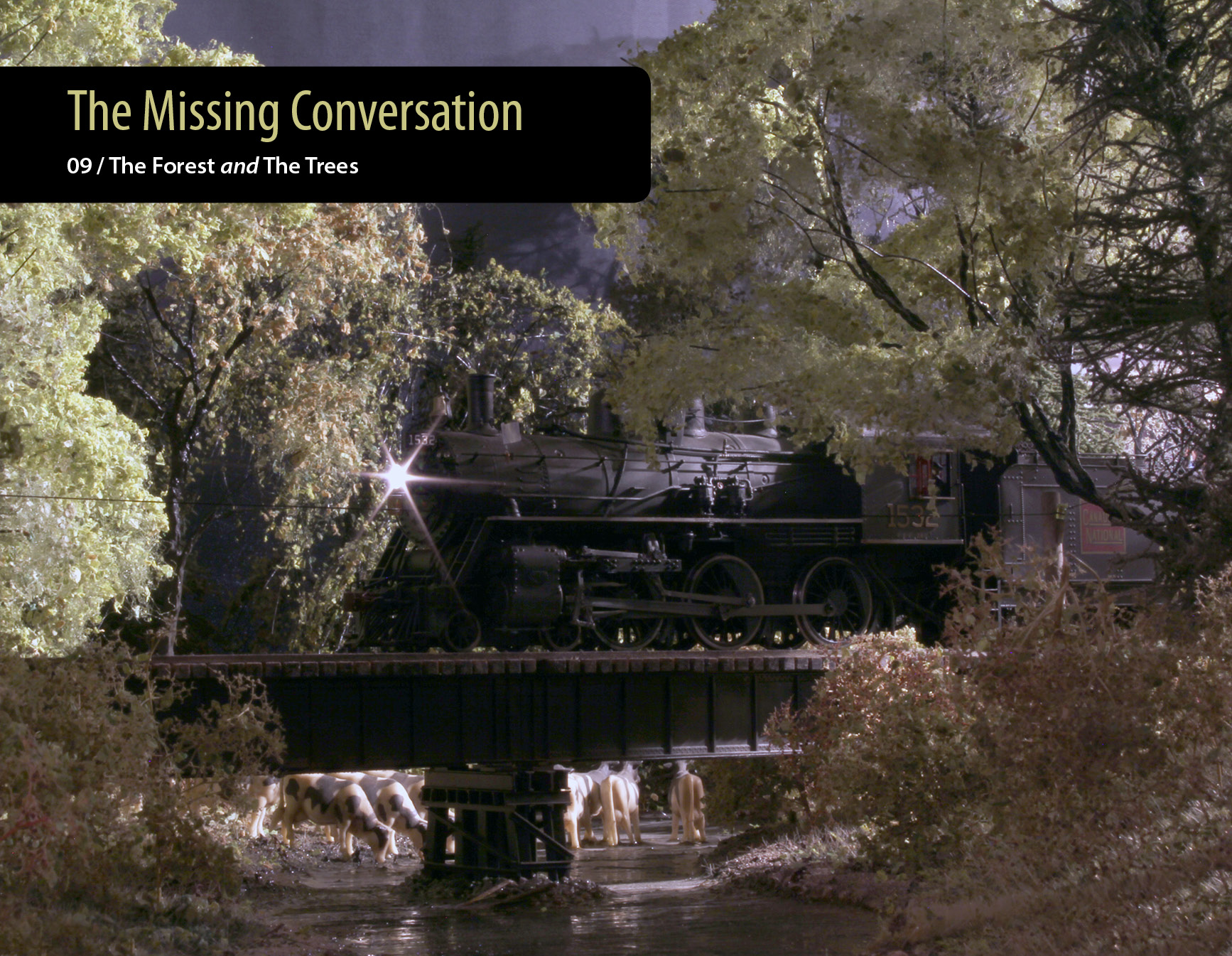
If you read this blog, then the chances are that you also read Mike Cougill’s blog, and may have followed the recent discussion on trees – and seen mention that publication of issue 9 of The Missing Conversation is nigh. As you will be aware from at least one of my previous posts, I hold this publisher’s oeuvre in high regard and indeed purchased the complete works! I regularly go back to them, as they provide insight and don’t just provoke thought, but provide training in how to see as an artist would see. A while back, sometime after I reviewed TMC on this blog, Mike asked if I would be prepared to help out by proof reading, and of course I bit his hand off over such an opportunity. This is not, however, the rare and cherished event because it happens at regular intervals: it is a privileged advantage.


Photo © Trevor Marshall. Published ℗ with permission of OST Publications Inc.

Photo © Trevor Marshall. Published ℗ with permission of OST Publications Inc.

No, the rare and cherished event is proof-reading TMC 09, which is about trees. It contains the following pieces:

Learning to See – Lose your preconceptions

The Forest and The Trees – How does a real forest grow

A Walk in The Woods by Trevor Marshall – How to use exemplary tree models effectively*

Prototype Studies – Four common tree types up close and personal as a masterclass in how to appreciate a tree

*This is not material taken from Trevor’s blog. It is a new and exclusive piece for TMC, and worth the cover price alone for the insight into his thinking.

TMC 09 is not about making model trees: as Mike and Trevor both point out, Gordon Gravett has recently written the definitive series on this. It is about what a tree looks like, and how to use them as a composition tool on a layout. As a guide on how to begin looking at trees, it is an essential precursor and primer to Gordon’s books for the dedicated finescale modeller.

I cannot add a disclaimer to this post: I am involved, and I get “paid” with a free copy (that is just a bonus as far as I am concerned). I am involved because I am helping a friend, and because I believe in what he is doing: making us think about why we model, and what we are trying to achieve, so that we get it right. Right to prototype. Right to scale. Right for our own personal needs.