OCE – Three Steps Closer to Perfection

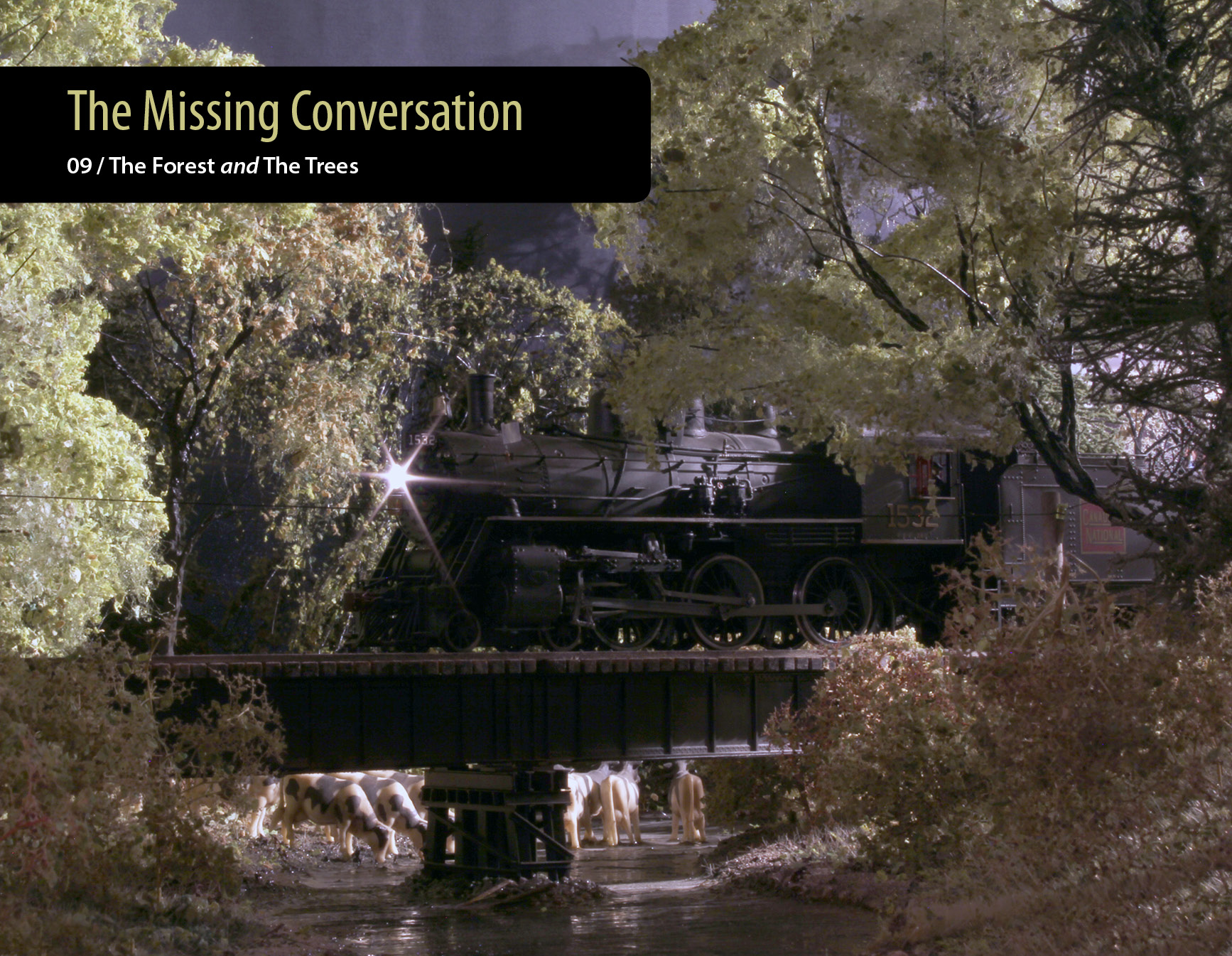
Have a look at this simple, beautiful picture:

wpid-x80w-lynnvalley-4sd.jpg
Picture reproduced by kind permission of Trevor Marshall
Just a train running through some woodland, next to a river, right? Yes. And also, no.

Yes: it is a train; there is woodland; and there is a river.

No: it is not just that; it is not even a simple case of the whole being more than the sum of the parts. There is more to it than that. But not too much more, and best of all, these are basic principles, attitudes and activities which can be applied to any creative activity, but which lie at the core of “finescale with feeling”.

  1. Observation – This could also be called “attention to detail”, in that it is about identifying the detail points in the prototype: the slope of the embankment (“fill”, if you are North American); the texture of the grass and leaves; the size and shape of the trees; the correct details on the train. If you get this stage wrong, then the result cannot be “closer to the prototype” and I would argue that it is not finescale. To get this right, spend time observing.
  2. Composition – How best to arrange things. Not as simple as it might seem. The prototype often disappoints in this respect: notable painter Constable altered the arrangement of the real world to improve his famous picture, “The Haywain”. Trevor has written some interesting musings on his composition of the Lynn Valley, and of course has put them into practice, too. There is a large element of “love of subject” here, as the aim is to make subtle adjustments to the real scene so that the model displays it all in the best light. This is feeling. To get this right, spend time immersed in information: books, photos, videos, site visits, and then play around with plans, card mock-ups, etc.
  3. Execution – The quality of workmanship. A high degree of skill is required (the hallmark of finescale) but also the care of that workmanship – back to feeling – makes this a believable representation of the real world, even if it isn’t an exact copy of a real place. This is true finescale with feeling. To develop and hone a skill, spend time getting a feel for tools and materials.

None of this comes automatically, except maybe to the very gifted few. Not all of us can reach the high standards displayed by Trevor, but as the major requirement for each of Observation, Composition and Execution is simply time, we can all try at our own pace, and each of these can be practised whenever and wherever desire and opportunity coincide.

At the end of the process, what do we see? Just a train running through some woodland, next to a river...

Can’t see the trees for the wood…

Sometimes, not often, I get a privileged advantage. Nothing major, you understand, just something simple within the hobby. This post is an example of one of these rare and cherished events.

If you read this blog, then the chances are that you also read Mike Cougill’s blog, and may have followed the recent discussion on trees – and seen mention that publication of issue 9 of The Missing Conversation is nigh. As you will be aware from at least one of my previous posts, I hold this publisher’s oeuvre in high regard and indeed purchased the complete works! I regularly go back to them, as they provide insight and don’t just provoke thought, but provide training in how to see as an artist would see. A while back, sometime after I reviewed TMC on this blog, Mike asked if I would be prepared to help out by proof reading, and of course I bit his hand off over such an opportunity. This is not, however, the rare and cherished event because it happens at regular intervals: it is a privileged advantage.


Photo © Trevor Marshall. Published ℗ with permission of OST Publications Inc.

Photo © Trevor Marshall. Published ℗ with permission of OST Publications Inc.

No, the rare and cherished event is proof-reading TMC 09, which is about trees. It contains the following pieces:

Learning to See – Lose your preconceptions

The Forest and The Trees – How does a real forest grow

A Walk in The Woods by Trevor Marshall – How to use exemplary tree models effectively*

Prototype Studies – Four common tree types up close and personal as a masterclass in how to appreciate a tree

*This is not material taken from Trevor’s blog. It is a new and exclusive piece for TMC, and worth the cover price alone for the insight into his thinking.

TMC 09 is not about making model trees: as Mike and Trevor both point out, Gordon Gravett has recently written the definitive series on this. It is about what a tree looks like, and how to use them as a composition tool on a layout. As a guide on how to begin looking at trees, it is an essential precursor and primer to Gordon’s books for the dedicated finescale modeller.

I cannot add a disclaimer to this post: I am involved, and I get “paid” with a free copy (that is just a bonus as far as I am concerned). I am involved because I am helping a friend, and because I believe in what he is doing: making us think about why we model, and what we are trying to achieve, so that we get it right. Right to prototype. Right to scale. Right for our own personal needs.


Armchairs

I have been amused by recent events on a web forum, relating to a letter published in a model railway magazine. The letter was pleasantly worded (I checked this with my wife, who is not so much a disinterested party as a supremely disinterested party) and made some observations relating to such things as the correct uniform and headgear for a policeman in that part of the country at that time, what sort of bus would be present and the paint scheme it would carry, and so forth. All in all, I would say this is really useful information, and it was offered freely so that the layout concerned could be even better – and so that anyone else interested in that particular time and place could take one step closer to creating a realistic scene. I am sure we have all watched films and TV shows and commented (or thought) that the train being used didn’t exist in the era or location in which the unfolding story is set. Well, this is that sort of issue: “Here is something I know, because at that time, I lived in the area. If you get this right, then your layout will be even more believable.”

The builder of the layout being “criticised” was upset about this and viewed it as very negative nit-picking, and was more than a bit churlish and childish about it. Unfortunately, the inevitable storm in a teacup ensued, and rather than point out that the letter actually required some effort to write and was intended to provide information of help to the layout builder so could he please calm down and put his toys back in the pram, his on-line “friends” sent him messages of support, and generally joined in the condemnation of the letter writer and the magazine editor for daring to print the letter and thereby increase the sum of human knowledge. Anyone attempting to put the other view was subject to the usual cyber-activities of ad hominem attacks rather than reasoned argument (difficult to put one, if there are no reasonable arguments). It was a disgusting sight, thankfully brought to my attention sometime after the event and the matter was deemed closed, so I managed to avoid making a silly arse of myself by getting involved. As my wife said, “It’s only toy trains at the end of the day.” As she is a community-based psychiatrist and is told to go forth, multiply and die a horrible death on a daily basis, she thought the abuse was quite lightweight, but she has seen internet bullying in action elsewhere and thought the above event was unpleasant. I only hope that the upset party has written a letter to the magazine, expressing his displeasure, so that the editor can print it and let the world see how petulant and petty some people can be in the face of criticism. I doubt that a response would be really necessary.

What, you may ask, has this to do with armchairs? Well, one of the more childish responses made against the letter writer was, “Until she [yes, it was a lady modeller] shows us that she has built a layout, and offered it for criticism, she can’t comment on anyone else’s layout”. This sort of line gets trotted out at regular intervals, often with the phrase “armchair modeller”, but just because it is regularly repeated doesn’t stop it being poppycock. On this basis, I cannot vote as I have never been a politician; I can’t proclaim my preference for Mozart over Beethoven as I have never written a concerto or symphony, and so on. (I presume that, although very amateurish, the fact that I have written directed and produced school plays, and help with scenery construction, lighting and even acted in amateur dramatics, I am allowed to have an opinion on the theatre, if not plays in general. Or am I restricted to amateur productions and pantomime?)

No, this is ludicrous. By all means react appropriately to people who tell you how you must conduct your modelling, especially if they have never done anything at all themselves, as this is rude and presumptuous of them. But offering an opinion? Suggesting a possible but different approach? Proffering more information? Since when have we ceased to have a free society, and one which requires experience of delivering entertainment/products/services rather than simply enjoying them before being able to think and talk about it?

Thankfully, the finescale modelling world seems more tolerant of people making an effort and the sharing of information, but can still fall back on the, “Where’s yours, then?” school of response. But may I suggest that next time someone politely offers a suggestion, provides information or even proffers criticism, ask yourself if they are trying to help you – and thank them if you think they are.