Category Archives: Craft

Gooderstone: yet another S scale GER branch terminus!

I have started constructing a new achievable layout, and have set up a page to record progress, which links to other pages as they appear (which requires me to make the requisite progress!)

The aim is to have a functionally operable layout by the end of 2026, with more scenic details etc to follow thereafter. Good progress is being made, but the reports will lag a little behind, so tune in occasionally, or subscribe to this blog and receive updates to the blog, pointing to a new page being added.

Enjoy if you visit!

PS. It does not seem possible to leave comments on pages, but the “leave a reply” option is available on posts for 2 weeks.

For looking and displaying, not operating…


My very good friend Mike Cougill is currently musing on how little “layout” one needs over on his blog.

Another very good friend, Chris Mears, has commented:
“Reading this and thinking about staging and backdrops made me think about a social construct the hobby perpetuates: that of inadequacy. We never have enough space in length of run for our trains, depth to model the whole scene, so sometimes these aids aren’t as much theatrical but concessions making up for what we want but can’t have.”

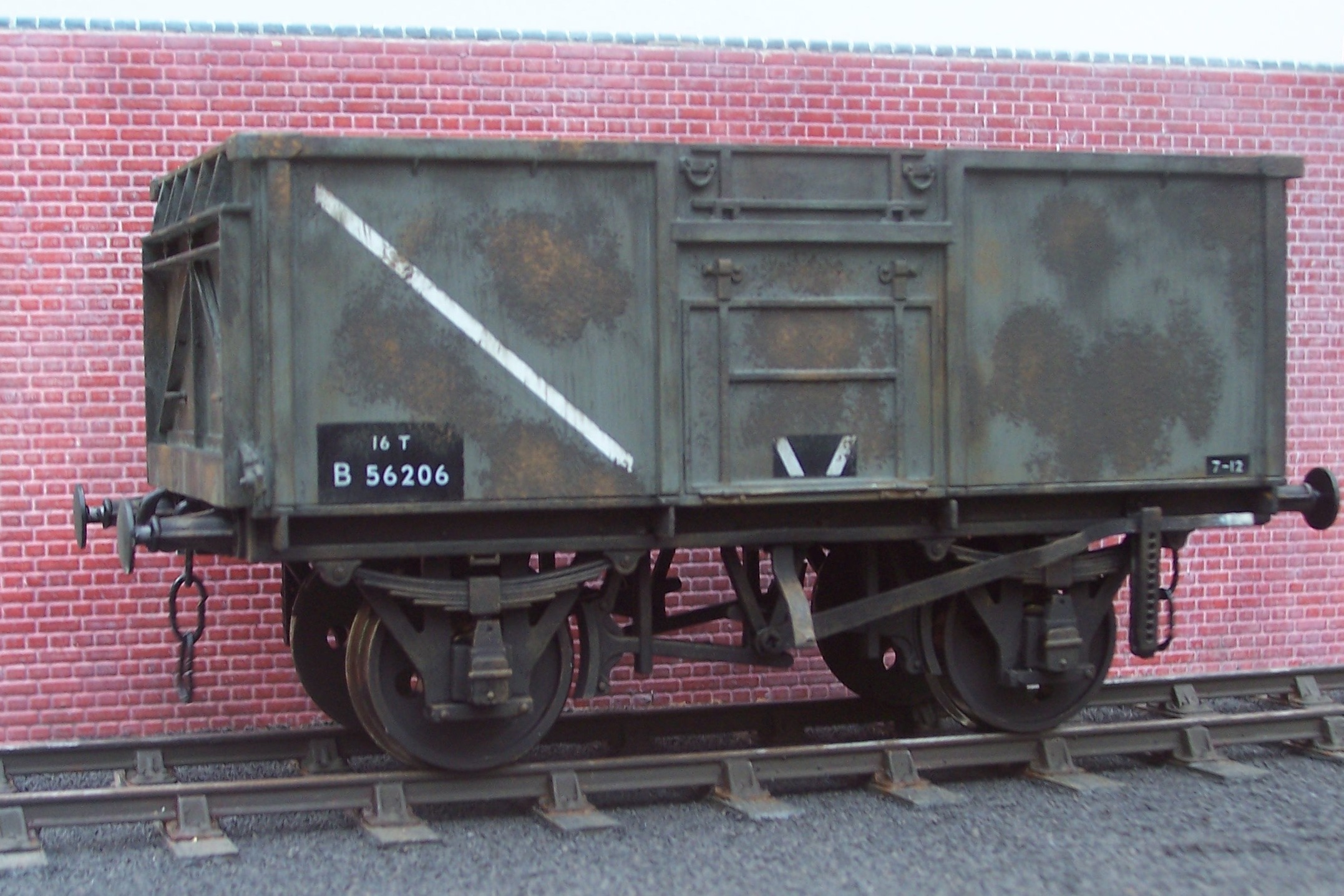
This reminded me of something I threw together more years ago than I care to remember in 1:32 scale. One of the magazines had a “100 square inches” competition. I didn’t enter, but a piece of particle board 12” long and 8½” wide was sorted out from the pile of bits of wood, and another piece screwed to the back of it. To this latter piece was affixed some vacuum-formed brick sheet (SEFinecast) with capping bricks from styrene strip. Painting was a base coat of a brick-like reddish colour with ultramarine blue for the capping, some additional dry brushing and once it had dried, thinned-down off-white applied wet at an angle (see Martyn Welch’s book on weathering) created the mortar lines. A bit of home-built track – lime wood sleepers, plastic chairs and rail, the latter two components from Cliff Barker’s range of code 180 rail, rounded off with some Woodland’s Scenics fine cinders ballast as ground cover. I spent longer waiting for glue and paint to dry than I did making it.


It served as a display track for a mineral wagon I had upgraded from an RTR model. I still have it somewhere…

Wisdom

I have tried to leave a comment on a friend’s blog, but Google (who own Blogger) appears to want none of it, unless I allow them more access to my on-line activity than I wish to (you can have it, guys, but if you value it so much, pay me for it!). On another blog, a friend is finding that the ”improvements” to WordPress (which i am using here) are not so much ”feature-laden” as ”feature-heavy” to the point of toppling over. He was happy with Blogger, until Google started messing around with it, so he moved to WordPress, and now they have given him more complexity which he didn’t want and taken away the simplicity he craved and originally had, all without asking him because, hey, more is more, yes? No, less is more. More is less…

Anyway,I was struck by the simplicity and vital importance of this remark:
“I know you can’t go cheap with turnouts”

So true, also for benchwork. Especially so if in staging under the rest of the layout!

Virtually everything else on a layout can be upgrade over time as money (if that is what is needed) is an issue, but poor benchwork from lack of investment in a few simple tools and by buying poor materials, and poor track work, from poor quality workmanship or buying poor quality ready made components (bearing in mind the improvements over time in such things as wheel manufacturing) will only result in regret. Anything else can be replaced: equipment, scenics, structures, control systems, even wiring.

Money invested wisely now is sound investment in the future happiness of the hobby!

(Actually, I generally think that other than as temporary stand-ins for basic scenics and placeholders for structures, where hardshell+zip and cardboard boxes will suffice, respectively, buying anything that is sub-standard is a complete waste of money: fewer models of high quality is a better place to start!)

Let it be,

Simon

A different perspective

In responding to a comment on Mike Cougill’s latest thought-inspiring post, I made reference to one of my own. (I also found some typos!) Re-reading what I wrote, an extra “contrary wise” thought came to me, and it’s worth highlighting here (in bold) as the downside to accepting ready-made objects straight from the box, warts and all:

As René pointed out, “Marty is right: don’t sweat the details, unless that’s your thing, in which case, don’t expect anyone else to notice.”

I would add that if you don’t sweat the details, hope nobody else will notice!

Sense of Place

I have written before about “love of subject”, and indeed mention it in the “about” sidebar entitled “Finescale With Feeling”. I think it provides a “grounding” for the modeller, and this shows in the results. That said, I wish I had done as good a job as Ken Karlewicz has in his YouTube video:

Our hobby needs more like this.

Thanks due to Trevor Marshall for introducing this to me.

Addendum: this layout is featured in the 2019 issue of Model Railroad Planning.