Category Archives: Modelling

Modelling activities

Shortline Inspiration 2: the Edgemoor and Manetta

This line in deepest South Carolina is a little gem, and thanks to Chris Ellis, editor of Model Trains (now, after various name changes, Model Trains International) is quite possibly better known in the UK than in its home country! It featured as long ago as 1980, with all 6 turnouts of the line (plus the interchange connection to and owned by the Seaboard Air Line, Atlanta Division) and a somewhat compressed plan. Although I can see the reasoning behind the latter (the plan would fit onto two shelves in the corner of a room, taking up 7′ x 7′, in H0) I feel that the compression goes too far and prototypical operations would be hard to replicate, particularly at the interchange. With Chris’ permission, the plan – along with a later version by Giles Barnabe for N scale – has been reproduced on RMWeb. (Click to open up a link.)

The prototype was a very short, short line about 2.3 miles long which ran from an interchange with the SAL at Edgemoor to the Mannetta mills at Lando (Manetta Mills owned the line). The line even managed to have a plate bridge over a river (with timber trestle approaches, which collapsed at least once!) In short, it had one of many of the features modellers look for.

E&M number 5
Trains latterly consisted of a Porter 0-4-0 tank engine, hauling up to two freight cars at a time! Freight was primarily coal in, and blankets out, generally requiring hoppers and boxcars. Trains were worked with the engine at the Lando (terminal) end: pushing up the hill to the interchange – sometimes pausing half-way to pump up more air – and pulling down to the mills. When delivering coal, the engine was trapped at the end of the coal ramp spur whilst the hoppers were emptied; coal was also delivered to the boiler house in the same manner. The engine itself was coaled by shovel, from a roadside truck whilst standing on the loopneck at the end of the line. The railroad also owned a flat car which never left Lando: once the day’s switching and shifting was done, it was left between warehouses separated by the tracks at the start of the loop to act as a platform allowing access between them! It had to be pulled out of the way at the start of the raiload shift, and put back at the end. The mills worked three shifts in 24 hours, but the railroad only operated for one of them. At the interchange, empties and deliveries were dropped off by passing ACL/SAL freights, which collected loaded cars and empty hoppers which had been left on the house track at Edgemoor. In earlier times there was even a passenger service, and the line ran with 0-4-4T and 0-4-2T power.

As big as a train can get on the E&M!

It was the last steam-worked non-tourist line in the USA, but operations ceased in July 1975 when the engine failed its boiler inspection. Trucks took over, and that was more or less that, although the loco was still there nine years later!

With a requirement of a small loco (it might be possible to use the old Rex loco as a starting point in S – anyone have one for sale?), half-a dozen boxcars, a couple of coal hoppers a gondola, a flat car and maybe a tank wagon, this would not be a difficult line to equip. I have sketched out an idea for a 12’8″ x 8’10” spare room, designed to feature most of the features of the line. Although I have had to come down to 42″ radius curves, I have used number 8 turnouts as even with a small engine and 40′ long freight cars, this simply looks better than anything tighter. If anyone wishes it, I can supply the plan as a Templot file, or – if you let me know the paper size – as a pdf for printing. There were warehouses both sides of the loop, the spurs served the coal traffic.

edgemoor_and_manetta

For further reading search out the following magazine articless:
Jim Boyd, “The Last Steam Shortline”, Railroad Model Craftsman, March 1972
Chris Ellis, “The Edgemoor and Manetta”, Model Trains, May 1980
Giles Barnabe, “Edgemoor and Manetta Revisited”, Scale Model Trains, May 1986
Giles Barnabe, “Edgemoor and Manetta RR”, Model Trains International, Issue 101
Finally, the Arcadia Publishing book, “Lando”, by Pual Scott Williams of the Lando-Manetta Mills History Center (2007, ISBN 9780738552682) has a lot of information, including the Sanborn Insurance map of the Manetta Mills and railroad tracks at Lando.

Setting out one’s stall

My friend Steve Cook has started a blog on modelling the Culm Valley Light Railway (see links to the side). This offers much promise, as Steve is a careful workman and a great advert for craftsmanship (I hope he isn’t blushing!) as you see already with his first few posts.

What I really liked, though, was his simple and clear statement about his aims, objectives and standards. Something from which we can all learn.


Happy Christmas one and all.


Simon

OCE – Three Steps Closer to Perfection

Have a look at this simple, beautiful picture:

wpid-x80w-lynnvalley-4sd.jpg
Picture reproduced by kind permission of Trevor Marshall
Just a train running through some woodland, next to a river, right? Yes. And also, no.

Yes: it is a train; there is woodland; and there is a river.

No: it is not just that; it is not even a simple case of the whole being more than the sum of the parts. There is more to it than that. But not too much more, and best of all, these are basic principles, attitudes and activities which can be applied to any creative activity, but which lie at the core of “finescale with feeling”.

  1. Observation – This could also be called “attention to detail”, in that it is about identifying the detail points in the prototype: the slope of the embankment (“fill”, if you are North American); the texture of the grass and leaves; the size and shape of the trees; the correct details on the train. If you get this stage wrong, then the result cannot be “closer to the prototype” and I would argue that it is not finescale. To get this right, spend time observing.
  2. Composition – How best to arrange things. Not as simple as it might seem. The prototype often disappoints in this respect: notable painter Constable altered the arrangement of the real world to improve his famous picture, “The Haywain”. Trevor has written some interesting musings on his composition of the Lynn Valley, and of course has put them into practice, too. There is a large element of “love of subject” here, as the aim is to make subtle adjustments to the real scene so that the model displays it all in the best light. This is feeling. To get this right, spend time immersed in information: books, photos, videos, site visits, and then play around with plans, card mock-ups, etc.
  3. Execution – The quality of workmanship. A high degree of skill is required (the hallmark of finescale) but also the care of that workmanship – back to feeling – makes this a believable representation of the real world, even if it isn’t an exact copy of a real place. This is true finescale with feeling. To develop and hone a skill, spend time getting a feel for tools and materials.

None of this comes automatically, except maybe to the very gifted few. Not all of us can reach the high standards displayed by Trevor, but as the major requirement for each of Observation, Composition and Execution is simply time, we can all try at our own pace, and each of these can be practised whenever and wherever desire and opportunity coincide.

At the end of the process, what do we see? Just a train running through some woodland, next to a river...

Physics Room 101

Well, it has been a while since I posted, but I have had little to say – I hope I have done it eloquently.

Anyway, I have been assembling L-girders, cutting sub road-bed, and generally making noise playing with power tools. More will come along soon enough, once glue has dried and my ideas have been proven.

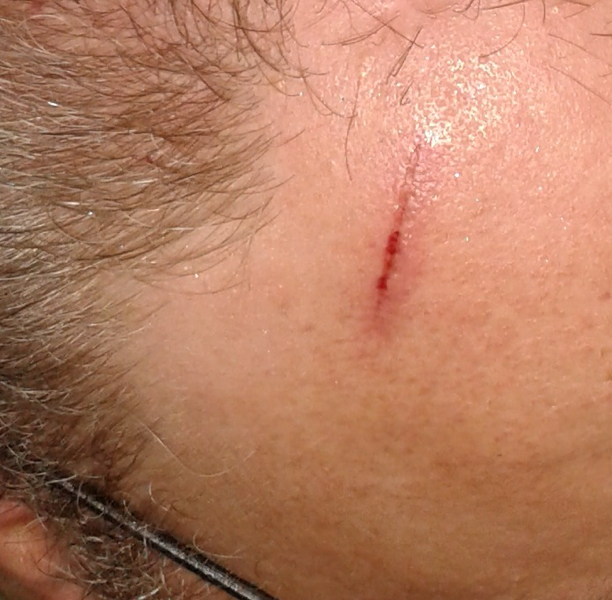
Today, however, was an opportunity for a (not so) gentle reminder of basic physics, involving an over-hanging L-girder rigidly if indirectly fixed to the wall as the immovable object, my body as the irresistable force*, and my forehead as the active participant in the lesson.

head

I’ll say this: as we’ll as being simple, quick and effective, L-girders are very robust…

* Someone, somewhere, must find it so…

Solifluction

Like me, the chances are you will have to look that up, but it is a geographical term relating to the effects of thawing and freezing of, for example, soil above permafrost. Each year, the thaw on the surface leads to over saturated soil above the permafrost, and it slips. Then it freezes again, and the cycle repeats. The consequence of all this is to create small steps in hillsides, etc, as show in the (linked) photo below from this very helpful page.

Solifluction in the Cairgorms

What has this to do with model railways? Well, recently there has been some discussion in various places, but particularly on Mike Cougill’s blog, about how great our hobby is from the perspective of personal satisfaction. We don’t just model a locomotive, as would someone building a radio-controlled vehicle, aircraft or boat. We model the whole scene, and also add movement and logical operation. (Nothing moves on a real railway without there being a purpose. This is also true of some layouts, where the builder has taken the trouble to find out about the real railway.) What the hobby teaches us, more than anything else – more than joinery, basic electrics and often some electronics, sculpting (of landforms), architecture, geography, history, economics, civil engineering, mechanical engineering, electrical engineering, metal working, use of tools,  and so on – is observation.

Observation of the real thing.

All good models start with an observation of the real thing. Generally speaking, unless you are building a model of something akin to the creations of Roland Emmet, railway modelling is not an abstract art – it is nowhere as difficult as that. As an art, it starts with observation. I learned about bonds used in brickwork from Iain Robinson (who has today introduced me to the word solifluction!), via the Railway Modeller, I have learned a lot about texture and colour from Barry Norman and Gordon Gravett. I have developed a love of history beyond railways thanks to the hobby – school put me off that! I could go on. (I often do, according to some many…)

Sometimes it works the other way round, too. I was motivated to learn about shading and perspective at school in art lessons by being allowed to do a perspective drawing of a railway station, with shading to show the direction of the sun. I also learned about observation from my 5th form (year 11, eleventh grade) art teacher, when trying to paint a tree and failing because I had used brown and not a few shades of grey (fewer than 50, I hasten to add!) In fact, I put my astounding performance* in my art exams at the age of 16 down to the drive to observe, rather than anything else, and that came from the hobby.

So, solifluction is another thing I have learned from the hobby, and I shall keep an eye out for it in future!

If you weren’t, you will now…

Simon

*In case anyone is wondering, the words “astounding performance” were used by my art teacher (not sarcastically), who had “inherited” our class from someone who had left part-way through the year, to describe my achievement against my natural ability. I failed.